11 items foundAdvanced Aerospace Designs
Informational 2018-12-17 TB Vigil Trade in Vigil I units
The promotional program for exchanging VIGIL I units will soon come to an end.
As from Jan 01st 2019 we shall be implementing a new scheme for the VIGIL I units that are still in use. Maintenance and battery change are not possible so we offer our customer to buy a new unit at a discounted price provided they return their old unit to the factory.
The cost will be 50€ per year in usage. The reference being the date of manufacture of the unit.
 Mandatory
2018-10-23 SB PSB 02-2018: Inspection on some Vigil II units
Mandatory
2018-10-23 SB PSB 02-2018: Inspection on some Vigil II units
Download file
Service Bulletin PSB 02-2018: Inspection on some Vigil II units
Issue Date : 23 October 2018
Subject : Mandatory inspection.
Compliance : MANDATORY: AT THE NEXT RESERVE REPACK, BUT NO LATER THAN 31 DECEMBER 2019.
Identification : VIGIL II units SN from 16000 to 21999. Applicable serial numbers can be found at https://www.vigil.aero/psb-check/
*** This bulletin does not have any military Vigil SN�s ***
Background : After inspecting a Vigil that had an unexpected activation, a flexible electrical connection inside the Vigil unit was found in a folded state. This caused an unreliable connection that resulted in a unit malfunctioning. To date, over 200 Vigil II units with the same type of flexible connection have been inspected during maintenance, and no other unit has been found with this problem.
Mandatory
2018-04-19 SB Firmware update and high altitude jumps
Advisory
2017-01-30 TB Vigil_Product_Advisory_01_2017
Download file
Battery ReplacementIdentification :
All VIGIL 1, & VIGIL II AAD's
Background:
Due to new IATA restrictions regarding the transportationlshipping of metal lithium batteries, we are no longer able to ship replacement batteries for the Vigil AAD, consequently forcing us to change the battery replacement procedures accordingly.
Effectively immediately, the battery is no longer field replaceable and must be returned to either AAD or Vigil America when a battery replacement is necessary.
Mandatory
2015-11-09 SB Vigil PSB 01-2015 Cutters manufactured March - July 2015
Download file
Subject: Vigil Cutters manufactured March 2015 – July 2015Compliance: Mandatory (See Compliance section for details.)
Identification: All Vigil AAD cutters with Date of Manufacture from 01 March 2015 through 31 July 2015. (3-15, 4-15, 5-15, 6-15 and 7-15) (mm-yy), whether or not the cutter is actually installed in a harness-container AAD system. All affected serial numbers of Vigil units and cutter hologram numbers can be found in List A (Cutters mounted on Vigil AADs at the factory or in the field) or List B (Spare part cutters), attached to this PSB.
Background: Upon investigating a report of a severed closing loop, it was determined that a rough edge inside the cutter abraded the loop fabric, causing it to fail. Inspection of other cutters revealed a limited range of cutters which could potentially have rough edges inside. Subject cutters appear to be more likely to abrade the closing loop in equipment where the cutter is placed above the pilot chute. We do not expect to find that every cutter in this range of cutters has an issue, but in the interest of saftey we are requiring that every cutter in this range be inspected. A.A.D. nv/sa has determined that all cutters identified as having been produced during the specified date of manufacture range (3-15, 4-15, 5-15, 6-15 and 7-15) (mm-yy), whether or not they are installed in a harnesscontainer- AAD system, must be recalled for in-house microscopic inspection at A.A.D. nv/sa, and that all reserve container closing loops with which a subject cutter was used must be replaced. After inspection of the returned subject cutter by A.A.D. nv/sa, a blue paint dot will be placed on top of the cutter to indicate that the cutter has been inspected and approved by A.A.D. nv/sa. A cutter will be returned, which will be accompanied by a new service card, dated and signed with a special stamp, confirming the inspection of the cutter. Front side Service Card Back side Service Card A.A.D. nv/sa has developed procedures to accomplish the cutter recall and to minimize the inconvenience to the users of parachute equipment containing a subject cutter.
Mandatory
2013-06-14 SB Vigil SB #09 Waterproof inspection of Vigil II
Download file
Background:
Upon checking returned Vigil II Multimode (Civilian model) units after water immersions,
A.A.D. nv/sa discovered, in some cases, high humidity inside the main box unit.
In one instance, the Vigil could not be switched on again after a water landing/water
immersion. In another instance, the Vigil continued working for several jumps after a
water landing/water immersion and then could not be switched on.
To avoid potential problems with the electronics in Vigil II Multimode (Civilian model)
units after contact with water, and possible malfunction of the unit, A.A.D. nv/sa must
inspect each Vigil II Multimode (Civilian model) unit, after it has been in contact with, or
immersed in, fresh or salt water, before the next jump.
Advisory
2013-06-14 SB Vigil SB #10 14Hrs automatic shutdown
Download file
Identification:
Vigil AAD II Multimode (Civilian Model), S/N 26172 or higher.
Date of Manufacture: 12-11 (mm-yy) or later
Main Software Version: 2.50 and higher (ver. 2.50 and higher)
Background:
There have been instances in which skydivers forgot to switch off their Vigil II Multimode
unit (with serial numbers below S/N 26172) before leaving a drop-zone and whose next
jump was at a different drop-zone, and who then forgot to switch them off and back on at
the ground level of the new take-off zones. In such circumstances, their Vigil II Multimode
(with serial numbers before S/N 26172) entered and remained in an �Airborne Status�
and, in some cases, even activated, due to the difference in ground reference altitudes.
Mandatory
2011-10-20 SB Vigil SB #08 Vigil Cutters
Download file
Identification:
Vigil AAD, All Cutters produced in October 2007
Part Number: 9582006
Date of Manufacture: 10-07 (mm-yy)
(See Photo 1.)
Background:
This SB-8 revises SB-7 to include additional serial numbers (see list B) and to add
additional guidance for compliance requirements.
The following incident occurred on the 14th September 2011 at the Saint-Jean Chrysostome
(Canada) drop zone:
A skydiver failed to deploy his main canopy and manually pulled his reserve handle with
insufficient altitude to fully deploy the reserve canopy. During the investigation of the incident
it was discovered that the loop was neither cut nor trapped by the cutter.
Mandatory
2011-10-04 SB Vigil SB #07 Vigil Cutters
Download file
Identification:
Vigil AAD, All Cutters produced in October 2007
Part Number: 9582006
Date of Manufacture: 10-07 (mm-yy)
(See Photo 1.)
Background:
The following incident occurred on the 14th September 2011 at the Saint-Jean Chrysostome
(Canada) drop zone:
A skydiver failed to deploy his main canopy and manually pulled his reserve handle with
insufficient altitude to fully deploy the reserve canopy. During the investigation of the incident
it was discovered that the loop was neither cut nor trapped by the cutter.
Advisory
2009-10-10 SB Vigil SB #05 Vigil Cutter Type 3
Download file
Identification:
Vigil AAD, All Cutters produced in December 2007
Part Number: 9582006
Date of Manufacture: 12 - 07 - 2 (mm/yy/Batch)
See pict.
Background:
After an activation of the cutter, the cutter body separated from its base.
This occured on the 19th September 2009 in Cerfontaine (Belgium).
Advisory
2007-02-21 SB Vigil SB #03 Vigil Cutters with Plastic Insert
Download file
Identification:Vigil AAD, All Cutters with Plastic Insert made before August 2006. Part Number: 9582006 Made Before August 2006
Background:
Cutters have been found in the field with damaged plastic inserts that have in turn damaged the closing loops. If the damage is severe enough, it is possible for the reserve-closing loop to sustain damage.
13 items foundAerodyne Research
Mandatory
2017-12-18 SB Aerodyne Semi-stowless Deployment Bag Replacement Program
Download file
Subject: Exchange of Aerodyne semi-stowless deployment bags supplied for Icon harness & container systems.Status: Mandatory.
Compliance: Completed by April 30th, 2018.
Authority: Gordon Sellers, President, Aerodyne Research LLC
Identification: All semi-stowless deployment bags, with side tuck tabs and magnetic mouth closure, sold with our Icon containers or as a spare part from June 2015 until October 31st, 2017.
This bulletin does not affect the semi-stowless deployment bags delivered after Nov. 1st, 2017, which have red stow pockets for the magnetic mouth closure system.
Background:
In 2015, Aerodyne began to offer a semi-stowless deployment bag as an option. In the last year there have been reported irregularities with premature releasing of lines (known as a line dump) where this bag has been in use.
Aerodyne has thousands of Icons in the field for many years with regular deployment bags using rubber stow bands with no known issues regarding line control during deployment.
Based on these reports, Aerodyne has performed additional tests on the design of the semi-stowless bag in different conditions. These conditions accounted for a wide variety of variables such as canopy sizes related to the bag size, types of canopy fabrics, types of lines, opening speeds, and more importantly, a variation of canopy packing techniques that we understand are used in the field. Through this additional testing we have determined that some of these conditions can exist, causing a premature release of lines from the bag. This uncontrolled deployment of lines may cause variations in opening characteristics, and could lead to lines being caught on the container or jumper.
As a result of continued development of Aerodyne’s products, an improved semistowless deployment bag has been designed which better addresses these issues. These bags are delivered with all new Icon containers where this option is required. To increase safety for everyone using the semi-stowless design, Aerodyne wishes to offer every Icon owner to have the latest version of this bag.
Thus, Aerodyne has decided to offer an exchange program and upgrade all the original semi-stowless deployment bags, and remove the first version of bags from further use. This replacement bag and return shipping to you will be at no charge to the customers, and will not distinguish if the bag is in a rig that is sold second hand. Simply put, if it’s an Aerodyne bag, Aerodyne will exchange it to the new version free of charge. Until users have received their new bags and wish to jump their equipment, we recommend that the packing instructions for the semi-stowless bag be noted and followed. We have experienced a variety of packing methods on the semistowless bags in the field, and would remind users that free stowing lines in any type of a semi-stowless bag is a technique that requires understanding and attention
Action Required:
In an effort to minimize disruption for our customers, we are in the process of manufacturing the new replacement bags and the practical exchange can start from the second week of January 2018. New semi-stowless deployment bags will be exchanged upon return of the original semi-stowless deployment bag. To prepare the exchange of these bags and for Aerodyne to manage program customers must register on Aerodyne’s website. This can be done as soon as possible.
Actions for customers to take: Visit http://www.flyaerodyne.com/registration and register your request for exchange. Please note this is important, even if you don’t send in the bag straight away. You will receive an email acknowledgement of your registration. Please keep this for your records. Please print and include a copy of this document when you return your bag for exchange. We will start the exchange process from the second week of January. Bags will be manufactured and made available in the order they are requested. The sooner you send your bag in, the earlier it will be replaced. With about 500 bags in 10 different sizes in the field, bags will be manufactured and made available in the order they are requested. Bags will only be exchanged upon receipt of old bag. If you have no need for a new bag immediately, please wait a while and let your skydiving friends who are active and maybe in a more jumpable climate get their bags first.
Informational
2012-12-01 TB Icon Reserve Pilot Chute Failed to Clear Side Flaps
Download file
Background :19 November 2012 it was reported that when the pin was pulled for routine repack, the reserve pilot chute failed to clear the side flaps and a video was provided as shown in the captures.
Closing Coment:
Judging by the customer provided video, it would appear and anomaly was produced from 2 contributing factors, one being an excessively long reserve closing loop and the other from initiating reserve deployment in an unconventional manor. After completing the 15 succsesfull test pulls we do not feel any corrective actions are nessessary.
Recommendation:
Riggers in the field should note that when opening a reserve for its schedualed repack that all manufacturers advise that it should be worn on the shoulders and actuation initiated by ripcord handle.
Mandatory
2011-03-25 SB Aviacom Argus AAD Installation Prohibited
Download file
Aerodyne prohibites the use of an Aviacom Argus AAD in all Icon harnesses.
Mandatory
2011-01-14 SB Icon Skyhook Riser Tuck Tab Modification
Download file
An accident with a Skyhook Icon Harness where the main risers were misrouted under the reserve tab
causing a riser cover to not release the main riser when the main was deployed.
Mandatory
2009-06-25 SB Icon Student S7, S8, S9 rigs
Download file
Aerodyne Research has identified a potential safety issue on certain student Icons. Icon student
rigs which have been manufactured with both a BOC hand deploy and ripcord/spring loaded main pilot chute
are affected by this service bulletin. We have seen an incident in which the bridle from the throw out was
temporarily snagged on the end of the ripcord housing installed on the number 3 closing flap of the main
container. The snag was cleared by the jumpmaster, and no one was injured. But we are concerned enough to
request that these rigs not be jumped with a throw out until a modification has been completed.
Optional
2008-01-25 SB Icon Container Alternate AAD Cutter Position
Download file
French Parachute Federation have certified it compulsory for
all Harness/Containers used in France must have the AAD
cutter fitted above the reserve spring loaded pilot chute.
The ICON Harness/Container was designed, tested and
certified with the AAD cutter positioned below the reserve
spring loaded pilot chute and positioned on reserve
Flap #1. Aerodyne has also certified the AAD cutter to be
positioned above the reserve spring loaded pilot chute.
Both positions of the AAD are approved and effective.
The Technical Bulletin is hence classified as optional.
Precautional
2007-11-27 SB Icon Container Grommet Inspection
Download file
A report back from the field revealed that there were some
damaged grommets on an ICON Container. The ICON
was returned to the manufacturer where it was determined
that the grommets had been damaged by the grommet
press.
Mandatory
2005-03-11 SB Icon Harness Container Cutaway Cable and Cable Housing
Download file
Cleaning the cutaway cable and cutaway cable housing
Optional
2004-07-12 SB Icon Harness Leg Strap Upgrade
Download file
The Icon harness leg strap consists of a single piece of type 7 webbing. To further increase friction and reduce slippage, an
additional piece of type 12 webbing is added to the leg strap and the
buffer described in technical bulletin TB 002 is removed. This service
bulletin is considered an upgrade or improvement to the existing design
in order to improve friction of the leg strap passing through the
stainless steel leg strap adjuster hardware. It is pertinent that the buffer
described in TB 002 is removed from the hardware once the type 12
webbing is added to the existing type 7 webbing. TB 002 of January
2004 is no longer recommended.
Informational
2004-05-01 TB Aerodyne Miniforce Risers
Download file
Because of the larger middle ring of the Aerodyne miniforce riser some checks must be done.
Informational
2004-05-01 TB Aerodyne Miniforce Tandem Risers
Download file
Because of the larger middle ring of the Aerodyne miniforce riser some checks must be done.
Informational
2004-01-01 TB Aerodyne Stainless Steel Adjuster
Download file
In order to improve friction of the leg strap passing through the
stainless steel leg strap adjuster hardware, it is recommended to add a buffer
in type 7 webbing.
Mandatory
2003-07-02 SB Aerodyne Ripcord Pin
Download file
All Ripcord Pins used on:
1.) Naro Harness and Container Systems (Excluding RSL curved pin)
2.) Teardrop Harness and Container Systems
Must conform to the Capewell Manufacturer SB
Nbr CW03-01, Issue Date 15 July 2003.14 items foundAirtec GmbH
Informational
2017-06-20 TB Airtec Cypres Cutter Reinforcement Kit
Informational
2017-01-26 TB Airtec Prolongation Cypres II lifetime from 12,5 to 15,5 years
Download file
For Cypres units manufactured after 01-01-2017, the service life is being extended from 12,5 to 15,5 years. Nevertheless maintenance is still recommended. Service intervals will be 5 year for that units.
Informational
2013-11-20 SB Cypres 2 units becoming non-responsive (Follow-up)
Download file
IMPORTANT Follow-Up to CYPRES 2 Service Bulletin C2 0113Additional included serial numbers and other important information.
Mandatory
2013-01-31 SB CYPRES 2 units becoming non-responsive.
Download file
Identification: CYPRES 2 units manufactured February 2009 through December 2012 (02/2009 - 12/2012).Compliance: MANDATORY before each jump
Background: Airtec GmbH & Co. KG has become aware of a small number of CYPRES 2 units becoming non-responsive. Although the subject units indicated a 0 (or the selected DZ setting) on the display, they were no longer operating. Extensive research indicates that this situation is extremely rare and tends to occur during packing, especially on non-static-proof surfaces such as plastic, nylon or carpeted areas. Low humidity, build-up of static electricity and changing environmental conditions are all contributing factors. In addition, a recent activation, after the rig had been placed on the packing mat, has been linked to this phenomenon.
Informational
2011-04-21 TB Rigging Information CYPRES Loop
Download file
The CYPRES loop, loop material and disc system, (with or without silicon treatment) has been designed, developed and manufactured at Airtec GmbH & Co. KG in Germany,
has been tested and approved ONLY in combination with the CYPRES AAD system. It has not been tested by us with any other AAD on the market and therefore
Airtec GmbH & Co. Kg can not take responsibility if our products are used in conjunction with other AADs. (for liability reasons) The CYPRES loop and disc system is not to be used in combination with other AAD-s)
Informational
2010-11-22 TB Rigging Information CYPRES Disc
Download file
ln September 2009 we were contacted by a rigger in Texas who reported that a
CYPRES disc tore in the web area between two of the holes,while repacking a Wings
container.
Informational
2010-10-29 TB Rigging Safety Notice
Download file
Notification to all skydivers, parachute riggers and rig manufacturers, in order for Cypres to do its intended job of cutting the reserve closing loop at the proper time, it is necessary that the Cypres closing loop be routed through the Cypres cutter.
Mandatory
2008-04-21 SB Airtec recalls 798 CYPRES II units
Download file
CYPRES 2 from the production period during August 2006 to October 2006.
The affected serial numbers are listed on the pages number 2 & 3.
Background :
Earlier this year we experienced two unwanted activations in Australia. Nobody was hurt. Both
units have been examined extensively at Airtec, with the finding that a defective sensor caused the
activation in both cases. As both units passed the more than 14 days period manufacturing testing
process without any noticable problems, we must assume that it is possible that there are more
units of this production batch in use with a similar sensor defect. As a precaution, we have decided
to recall all potentially affected CYPRES 2s for a preventive sensor replacement.
Mandatory
2008-01-22 SB Actions in case of an incomplete selftest
Download file
On the 29th of December 2007 in Eloy, AZ, USA a Cypres2 unit activated a few seconds after
exit. The Cypres showed problems with the switch-on several times the days before. An attempt to
switch on the unit before the skydive was made, and nothing was seen on the display, but it
was decided to use the parachute anyway. Fortunately there were no injuries.
Advisory
2004-12-01 TB Airtec Loop Cutter Location Recommendation
Download file
As the packing of very small reserve containers is getting more and more
sophisticated, we see a cutter position above the pilotchute as being a very easy and
inexpensive way to significantly increase safety. Many factors which neither the
container manufacturer nor the AAD manufacturer have any influence over, can be
eliminated. We appreciate the action Mirage is taking with this PSB because it
eliminates possible side effects from a lot of field rigging errors which no
manufacturer can prevent. We encourage other manufacturers of containers with
internal pilotchutes to evaluate this cutter location and take similar action as is
appropriate.
Informational
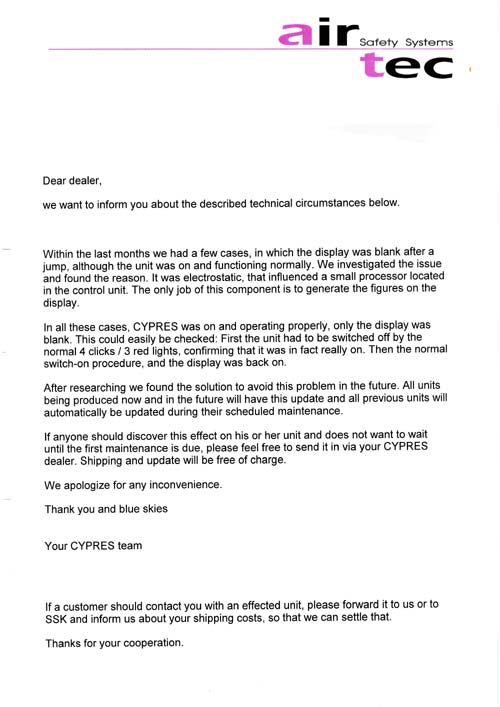
2003-08-01 TB Blank display after switch on
 Download file
In some cases display units went blank after switch on. Electrostatical influence on the control unit caused this problem. A solution was found and will be updated at the next inspection.
Download file
In some cases display units went blank after switch on. Electrostatical influence on the control unit caused this problem. A solution was found and will be updated at the next inspection.
Informational
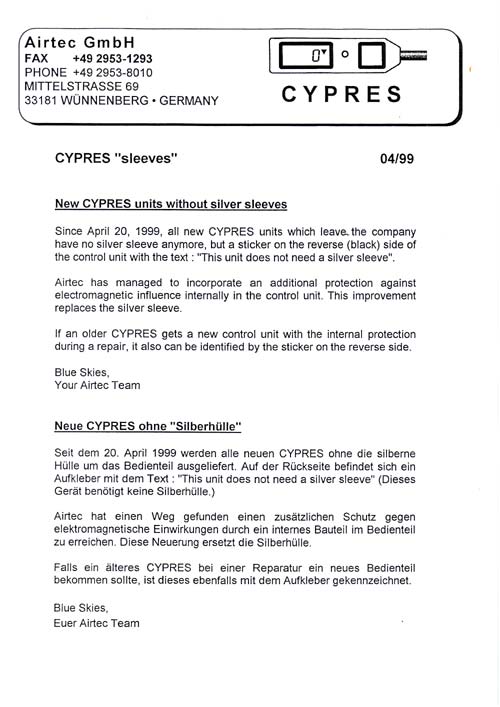
1999-04-20 TB New Cypres units without silver sleeve
 Download file
Since 20 April 1999, all new cypres units which leave the company have no silver sleeve anymore, but a sticker on the reverse (back) side of the control unit with the text "This unit does not need a silver sleeve"
Download file
Since 20 April 1999, all new cypres units which leave the company have no silver sleeve anymore, but a sticker on the reverse (back) side of the control unit with the text "This unit does not need a silver sleeve"
Advisory
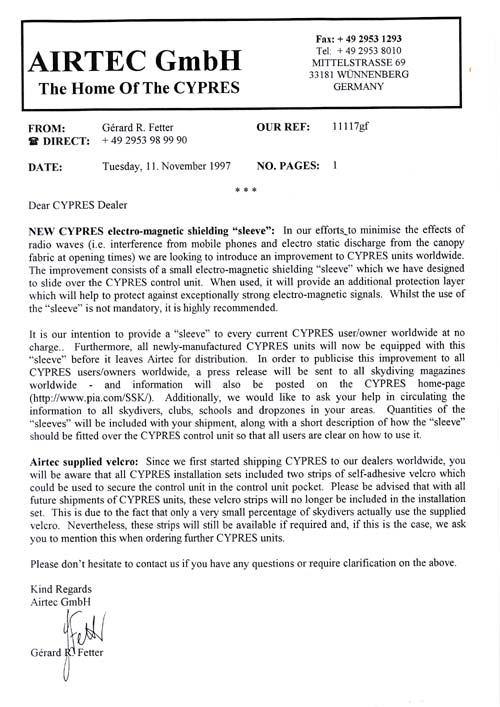
1997-11-11 TB New Cypres electromagnetic shielding sleeve
 Download file
Mandatory
1994-01-01 SB Airtec recalls 1527 CYPRES I units
Download file
Airtec recalls 1527 units released between 26/08/1993 and 02/11/19939 items foundAviacom NV
Mandatory
2014-06-13 SB Argus SB AMMO130514/1 Mandatoy Functional Check-up
Download file
Background:A significant number of Argus units come in for the functional check-up well overdue of the four year cycle.
Every 4 years the Argus SIS must have a functional check-up at a local Authorized Service Center.
Service bulletin:
All systems that had their last functional check-up carried out over 4 years + 3 months are considered not airworthy and should not be installed in any parachute system. All units of which the serial number appears upon attached list are NOT AIRWORTHY. The functional check-up is only valid when carried out at an authorized service center:
Mandatory
2011-08-05 SB Argus immediate and mandatory cutter replacement
Download file
SB AMMO050811Argus Cutter PN# manufactured before Sept. 07 and manufactured for Aviacom SA by Nobel Energetics
This service bulletin has been issued in response to the findings of the final report of the Polish Authorities and by recommendation of the USPA after recent incidents
Mandatory
2011-04-05 SB Argus mandatory cutter replacement
Download file
SB AMMO050910/4Argus Cutter with manufacturing dates Aug. 07 or earlier and manufactured for the Argus AAD by Nobel Energetics
This Service Bulletin replaces SB AMMO050910/3
Mandatory
2010-12-07 SB Argus mandatory cutter replacement
Download file
SB AMMO050910/3Extended period for mandatory cutter replacement
Argus Cutter with manufacturing date Aug. 07 or earlier and manufactured for the Argus AAD by Nobel Energetics
This Service Bulletin replaces SB AMMO050910/2
Advisory
2010-12-07 SB Argus substandard loop washers
Download file
SB AMMO071210/1Loop washers better known as smiley. In general used in parachute systems equipped with an electronic AAD. Discs can break or rip from hole to hole.
Mandatory
2010-09-05 SB Argus mandatory cutter replacement
Download file
SB AMMO050910/2Argus Cutter with manufacturing date Aug. 2007 or earlier and manufactured for the Argus AAD by Nobel Energetics
Mandatory
2006-12-11 SB Argus in Mirage Systems
Download file
This bulletin cancels and replaces SB AMM021206/1Mandatory cutter replacement on Mirage rigs
Mandatory
2006-12-02 SB Argus in Mirage Systems
Download file
Mandatory cutter replacement in Mirage rigs
Mandatory
2006-05-29 SB Argus fire on the ground
Download file
A bug was discovered in the May 2006 batch, due to last minute software update that obviouslywent wrong. Some units are to be recalled and after upgrade to be shipped back to the owners
after testing.
5 items foundBasik Air Concept
Mandatory
2011-03-31 SB Argus in Advance harness
Download file
BASIK AIR CONCEPT Statement about the use of AADs in all Advance and Seven
Harness Container Systems.
Mandatory
2007-07-18 SB Advance Tandem
Download file
Advance Tandem T1 and T2 manufactured before April 2006. Verify
the left side diagonal backstrap at the Oeticker clamp level which maintain the
reserve housing located on the shoulder right beside the 3 ring system.
Mandatory
2006-09-14 SB Argus Advance Interdiction
Download file
Basik Air Concept does not allow at all, the installation and the use or the Argus AAD system
into its harness /containers systems type: Advance OUT, Advance IN and Advance Tandem.
Mandatory
2001-11-05 SB Advance Harness Addendum
Download file
Stiches on a legstrap failed during a premature opening while freeflying
Mandatory
2001-08-05 SB Advance Harness
Download file
Check loose pouches on Advance Harness / Container as from serialnumber 11001 items foundCapewell Components
Mandatory
2003-07-15 SB Capewell broken pins
Download file
Capewell Components LLC has received reports from customers of ripcord pins that broke. All pins were reported to have broken under very low force.8 items foundFirebird GmbH & Co. KG
Mandatory 2019-03-30 SB Firebird PSB 2019-01 Reserve Pin Ripcord assemblies on EVO harness containers
Firebird PSB 2019-01 Reserve Pin Ripcord assemblies on EVO harness containers
Status : Mandatory before next jump
All Firebird EVO HC with Pillow Ripcord assemblies PN012 built between April 2018 - March 2019, Serial Numbers BD001 - CB010. Some ripcords are showing no Swage on the ripcord pin.
Informational
2017-05-22 TB Firebird Compatibility of products
Advisory
2014-01-08 TB Omega Tandem Reserve Handle with handycam use
Download file
Possibility of a premature opening of a reserve canopy in case a Tandemmaster uses a HandyCam.
Mandatory
2011-03-25 SB Aviacom Argus AAD Installation Prohibited
Download file
This harnesses may not be packed by the technical if an Argus is installed. Skydivers who use this system must have the
AAD removed before next jump.
Mandatory
2011-03-17 SB Omega EVO Double RSL ring
Download file
All EVO harnesses with a RSL connection as shown on attached picture with 1 ring possibly can cause a hookup on the cable housing resulting in damage to the bracket on the reserve flap.
Therefor all containers with a RSL must be modified according to the displayed image. Firebird offers this modification free of charge.
Mandatory
2007-02-20 SB Cutter relocation Firebird Omega
Download file
In order to avoid delays on opening the reserve parachute in case of an AAD fire, Firebird decided to relocate the AAD cutter from position under the 1st closing flap to flap 3 above the spring pilot chute for his Omega.
Mandatory
2007-02-20 SB Cutter recolation on Firebird Tandem
Download file
In order to avoid delays on opening the reserve parachute in case of an AAD fire, Firebird decided to relocate the AAD cutter from position under the 1st closing flap to flap 3 above the spring pilot chute for his Firebird Tandem rig.
Mandatory
2005-07-18 SB Bartacks on Omega Container-System
Download file
One or more Lines were entangled with main container flap No. 2To avoid failure like written above and during improper use of the equipment in the future, the mirror (Flap No. 3 of the reserve container) must be sewed at the round corners with two short bartec to the flap No. 1 of the reserve container. This avoid contraction of the flap under tension while a line is tucked under. And it is easier to turn up the flap to release a line.
1 items foundIcarus Canopies Inc.
Recommended
2011-07-27 SB Icarus Canopies - NEOS hard openings
Download file
This SB is applicable to all NEOS parachutes P/N 317524/XXX for serial numbers prior to 24112612 in all canopy sizes.
Action : replace the C1 line.50 items foundMarS
Mandatory
2016-09-30 SB MarS SB_20160902_M2 AAD Cutter replacement
Download file
Background:The cutter cable insulation has cracked on some MarS m2 AAD cutters as shown in Fig. 1. Investigation by the manufacturer has shown that this is caused by the method used to close and seal the cutter body. The cracking only affects the insulation, and the function of the device is unaffected. However, as a precaution, all cutters that are affected by this bulletin must be replaced
Service Bulletin Procedure:
a. If a problem exists with the cutter this will be detected by the control unit and displayed as an error No.2. In this case, the cutter must be replaced immediately. b. If no error is detected, then the AAD may remain in use until the next repack cycle. During the next regular repack the cutter must be inspected and replaced if it is affected by this bulletin. c. The rigger shall make an entry on the packing data card stating that the installed cutter is not affected by the bulletin. d. A replacement cutter may be obtained directly from MarS, or from an m2 distributor. The affected cutter should be sent to the manufacturer, or to an m2 distributor. e. The cost of the replacement cutter and of shipping the replacement cutter to the user will be covered by the manufacturer.
Compliance Date:
Mandatory before the next jump.
Mandatory
2015-10-06 SB MarS SB_20151006_Configuration change in the reserve parachute packing when cutting the reserve container closing loop
Download file
1. REGARDS: Sport container types OP-087, OP-093, OP-095 T and OP-103 of all sizes and variations made by the MarS a.s. company in combination with the MPAAD safety device, serviced according to Service Bulletin SB no.11/11/2013.
2. REASON: The MPAAD device was introduced to parachute operation in 2003 after successful tests. Many years of practical use by hundreds of users have revealed there is an increased sensitivity of the reserve parachute container closing loop cutting system at the bottom of the container, requiring very precise compliance with all the instructions and conditions for packing as specified by the manufacturer. Possible failure to follow these instructions and conditions, in combination with other unpredictable factors, could lead to malfunction of the entire system of the reserve parachute opening upon activation of the safety device that cuts the closing loop at the bottom of the parachute container.
This Service Bulletin is issued as a precautionary measure to increase the safety of the parachute rigs manufactured by MarS a.s.
3. MEASURES: a) The parachute containers with the MPAD safety device in question must be sent to the manufacturer for replacement of the MPAAD device into the parachute container at the top of the container, above the reserve pilot chute.
b) As part of the device exchange, all of the necessary amendments will be performed on the parachute container to allow installation of the m2 safety device.
c) The device exchange and parachute container amendments will be performed without charge, at the expense of the manufacturer.
d) The m2 safety device lifetime will equal at least the remaining lifetime of the original MPAAD safety device on the serviced parachute container.
4. VALIDITY: From the issue date of the Bulletin.
Binding
2015-03-03 SB MarS SB_20150303_Extending the lifetime of parachute containers with harness and reserves parachutes
Download file
1. CONCERNS:
A) Parachute containers OP-087, OP-093 and OP-093/01 with harnesses and parts / ripcords handle reserve, three ring release ripcords handle / (hereinafter containers with harnesses),
B) Reserve parachutes /WITTY PLUS, WP-110,WP-130,WP-150,WP-175, WP-210, WP-260, WP-370/ and reserve parachutes PZS-92
(hereinafter reserve parachutes),
produced by company MarS spol. s r.o. or MarS a.s., used in civilian air sector of which were by manufacturer extension lifetime.
2. REASON: Increasing the user comfort related to the extension of containers with harnesses lifetime and reserve parachutes in relation to compliant results of the technical inspections performed at the manufacturer site by the existing procedure until now.
3. MEASURES: Extending the lifetime by person authorized
Lifetime can be extended to total lifetime 20 years without repeated technical inspections at the manufacturer�s site.
The inspection by person authorized:
The person authorized I (the packer of the reserve parachute with valid authorization for the specific type of reserve canopy) performing:
- the reserve canopy packing for use (into reserve container), must
perform the inspection of the reserve canopy and harness / container, their
completeness and technical state prior to their packaging for use.
The inspection or technical inspection by person authorized:
The person authorized II (the parachute technician and senior parachute technician with valid authorization), performing:
- the reserve canopy packing for use (into reserve container), must perform the inspection of the reserve canopy and harness / container, their completeness and technical state prior to their packaging for use,
- the technical inspection, must check the completeness and technical state of the reserve canopy and harness / container.
If the state of the container with the harness or the reserve parachute is suitable, person authorized I, II will confirm the parachute eligibility for further operation in the technical certificate until the next deadline for the parachute repacking.
After completing a technical inspection with result �suitable for use�, the person authorized II will confirm by the record in the technical certificate the date of validity until the next technical inspection.
The person authorized can apply this procedure until using the total lifetime of the parachute max. 20 years.
In case when the technical state of the container with the harness or the reserve parachute �is not suitable for use�, the parachute must be placed out of operation, and the replacement of incompliant parts must be performed, or the harness / container or reserve canopy must be sent to the manufacturer for repair.
The manufacturer will recommend the performance of potential repair work of the parachute or eliminate the parachute from operation and terminate its use.
If harnesses / containers or reserve canopies have extended life (from the manufacturer's authorized person), then the manufacturer or an authorized person doesn�t guarantee for their function and in the event of an emergency are not responsible for any damage to health and property.
4. VALIDITY: From date of bulleting issue.
5. ANNEXES: Technical certificate of the container with harness
� the completion procedure from the person authorized II.
Binding
2015-02-02 SB MarS SB_20150202_Extending the lifetime of parachute containers with harness and reserves parachutes
Download file
1. CONCERNS:
A) Parachute containers OP-087, OP-093 and OP-093/01 with harnesses and parts / ripcords handle reserve, three ring release ripcords handle / (hereinafter containers with harnesses),
B) Reserve parachutes /WITTY PLUS, WP-110,WP-130,WP-150,WP-175, WP-210, WP-260, WP-370/ and reserve parachutes PZS-92 (hereinafter reserve parachutes),
produced by company MarS spol. s r.o. or MarS a.s., used in civilian air sector.
2. REASON: Increasing the user comfort related to the extension of containers with harnesses lifetime and reserve parachutes in relation to compliant results of the technical inspections performed at the manufacturer site by the existing procedure until now.
3. MEASURES: Extending the lifetime
Lifetime can be extended from 15 years to total lifetime 20 years without repeated technical inspections at the manufacturer�s site.
The user will send to the manufacturer the container with the harness or reserve parachute subject to the extension period with their technical certificate before to the termination of 15 year service life.
Technical inspection at the manufacturer:
A) The manufacturer will perform technical inspection of the container with the harness and decide on the lifetime extension approval or disapproval over 15 years.
The manufacturer also evaluates the types of straps used for producing the harness. If it is made of straps which do not comply with the regulations specified for the basic lifetime extension � the lifetime of such harnesses will not be extended over 15 years. Further extension is subject to the strap replacement � i.e. new harness will be produced in the container.
B) The manufacturer will perform technical inspection of the reserve parachute and decide on the lifetime extension approval or disapproval over 15 years.
After technical inspection of the container with harness or the reserve parachute, the manufacturer will complete the record of performed inspection in the technical certificate. In case of satisfactory inspection, the manufacturer will complete a record of lifetime extensions to the total lifetime max. 20 years.
NOTIFICATION:
During the period the containers with harnesses or reserve parachutes do not have extended lifetime by the manufacturer, the manufacturer does not guarantee the function, and in case of exceptional event it is not responsible for potential damages to health and property.
After completing the technical inspection of the container with the harness or the reserve parachute after the basic lifetime of 15 years with compliant result, the manufacturer can specify the lifetime of the container with the harness or reserve parachute according to its physical state for the period shorter than the maximum of 20 years.
In case the total lifetime after 15 years was extended to less than 20 years, it is possible to send the container with the harness or the reserve parachute for repeated evaluation of the state solely to the manufacturer.
In case the total lifetime was extended by the manufacturer from 15 years to 20 years, the persons authorized can perform the inspections of containers with harnesses or reserve parachutes during the last 5 years of the lifetime.
The inspection by person authorized:
The person authorized I (the packer of the reserve parachute with valid authorization for the specific type of parachute) performing the parachute packing for use, must perform the inspection of the parachute completeness and its technical state prior to its packaging for use.
The inspection or technical inspection by person authorized:
The person authorized II (the parachute technician and senior parachute technician with valid authorization), performing:
- the parachute packing for use, must perform the inspection of the parachute completeness and its technical state prior to its packaging for use,
- the technical inspection, must check the technical state and completeness of the parachute.
If the state of the container with the harness or the reserve parachute is suitable, person authorized I, II will confirm the parachute eligibility for further operation in the technical certificate until the next deadline for the parachute repacking.
After completing a technical inspection with result �suitable for use�, the person authorized II will confirm by the record in the technical certificate the date of validity until the next technical inspection.
The person authorized can apply this procedure until using the total lifetime of the parachute max. 20 years.
In case when the technical state of the container with the harness or the reserve parachute �is not suitable for use�, the parachute must be placed out of operation, and the replacement of incompliant parts must be performed, or the parachute must be sent to the manufacturer for repair.
The manufacturer will recommend the performance of potential repair work of the parachute or eliminate the parachute from operation and terminate its use.
4. VALIDITY: From date of issue.
The issue of this Service bulletin terminates the applicability of the Service bulletin issues:
03/01/2014 from 24. 01. 2014 � Extension of basic timelife of sport parachutes parts over 15 years � specification of conditions.
01/01/2013 from 14. 01. 2013 � Extension of timelife of reserve canopy WP over 15 years.
02/05/2011 from 12. 05. 2011 � Extension of timelife of reserve canopy PZS-92 over 15 years � specification of conditions.
5. ANNEXES: Annex No. 1
Technical certificate of the container with harness � the completion procedure from the manufacturer.
Binding
2014-12-15 SB Mars SB_08/12/2014_Inspection the configuration used by the connection of the main deployment bag and the pilot chute (kill-line)
Mandatory
2014-10-14 SB Mars SB_20141014_Clarification of PR-011 Spring Opening Band position on the packed parachute container for parachutes range PL-70
Download file
1. SUBJECT MATTER: Emergency pilot parachute PL-70-I/K, PL-70-I/L, PL-70-I.
2. REASON: Addition the text to the Technical Description - Clarification of PR-011 Spring Opening Band position on the packed parachute container for parachutes range PL-70.
3. COMPILANCE: Prevention - The measures are specified in annex no. 1, 2, and 3 hereto.
4. APPROVAL The service bulletin is issued on the base of the approved non-significant change no. 24/14.
5. VALIDITY: From the date of the service bulleting issue.
6. ANNEXES: Annex no. 1 � Complement of the Technical Description no. P-001-97; Annex no. 2 � Complement of the Technical Description no. P-002-97; Annex no. 3 � Complement of the Technical Description no. P-003-97.
7. PROCESSING: The user of the parachute will process the �Complement� in formerly issued Technical Descriptions no. P-001-97, P-002-97 or P-003-97 by printing annex no. 1, 2 or 3 of the service bulletin in format A5 and stick it on the last page.
8. DATE OF ISSUE: In Jev�cko on 14.10.14
Conditional
2014-06-10 SB Mars SB_M ATL-01-14_Change of the mode for extending the lifetime of emergency parachutes ATL
Informational
2014-01-03 SB MarS SB_20140103_Extension of basic lifetime of sport parachutes parts over 15 years � specification of conditions
Download file
1. CONCERNS: Parachute containers OP-087 and OP-093/01 with harnesses
and parts (Ripcord Handle Reserve, Three Ring Release
Ripcord) by sport parachutes produced by company
MarS spol. s r.o. or MarS a.s., used in civilian air sector.
2. REASON: Possibility of extension of basic lifetime of parts in point 1 over
the given basic lifetime.
3. PROCEEDING: Basic lifetime of parts in point 1 is 15 years from the
production date under condition that instructions stated in
Technical description are followed.
User will send parts including Technical certificate of the
parachute container with the harness with correct and full user's
records (of all checks, repairs) to the producer for checking
before the basic lifetime of 15 years is terminated.
Producer will carry out a detailed check of individual parts and
on the basis of their physical condition the producer decides
about extension or non-extension of their basic lifetime over
15 years.
In case of successful check the producer will extend the basic
lifetime � maximum by 2 years.
Interval of lifetime extension is counted always from the date of
basic lifetime termination.
Producer make a note in the Technical certificate about the
carried out check and in case of successful check also a note of
lifetime extension, or a note of repair.
With parts in excellent condition, it is possible to extend the
lifetime repeatedly.
Further lifetime extension in case of successful check is possible
in the length of maximum 2 years starting the date of the
extended lifetime termination.
It is possible to repeat such proceedings with well-preserved
parts but only until the complete lifetime of 20 years.
If the user does not present parts before its lifetime runs out, it
will only be extended until the lifetime extension date in the
immediate future. From the production date.
WARNING:
During the time, when the parts do not have extended
lifetime, the producer does not guarantee their function and
in case of exceptional situation the producer does not have
responsibility for possible damage on health or property.
4. VALIDITY: From date of bulleting issue.
By issuing of this Service Bulletin, the validity of Service
Bulletin no. 12/12/2010 from 15.12.2010 is cancelled and this
Service Bulletin contributes to facts of Service Bulletin no.
1/01/2003 from 10.01.2003 in point 2 C about possibility of
extension of basic lifetime.
Mandatory
2014-01-01 SB Mars SB_20140101_Failing_reserve_opening_on_some_harnesses
Download file
The reserve parachute container flaps failed to open completely
during the exercise land opening of the reserve parachute container
in the above design, after releasing the ripcord handle reserve. The
upper covering flap of the reserve parachute container remained
trapped behind the reinforcement edge of the lower (central) flap of
the reserve parachute container.
Mandatory
2013-11-27 SB Mars SB_11/11/2013_Renwal the diving performance
Mandatory
2013-11-11 SB Mars SB_20131110_Inspection_m2_AAD
Download file
Error Messages - Inspection of m2 (AAD)
Compliance : Mandatory
Identification : m2 Safety Devices with serial numbers:
SN: 001330 – 001379;
SN: 001384 – 001446
SN: 001556 – 001727
Background:
During operation of m2
Safety Devices to date, there have been seven (7) reported
cases of “Error No. 0” or “Error No. 1” being displayed on the units. Further, it was not
possible to eliminate the error indication by switching the unit off and on again.
Inspection by the manufacturer disclosed a device sensor error. The error is repairable
by the manufacturer in affected units.
Mandatory
2013-10-09 SB Mars SB_20131009_Interruption_of_diving_performance
Download file
WARNING:
If the parachute sets above are completed without device MPAAD, or include different security device (e.g. m2, CYPRES, VIGIL), the interruption does not relate to the parachute sets.
If MPAAD device is installed and not used, correct function of the parachute container remains maintained � during the reserve parachute opening by means of rip cord of the reserve parachute.
Mandatory
2013-06-05 SB Mars SB_20130605_Interruption_of_diving_performance
Download file
The elimination of reserve parachute container malfunction if using the MPAAD device in case of incompliance with the specified length of the closing loop during the parachute packaging.
The manufacturer decision within information collection, inspection of the parachute sets, and the tests and analysis.
Mandatory
2013-01-02 SB Mars SB_20130102_Use_of_reserve_pilotchute_PV-028
Download file
In assembling with reserve parachute is possible to use Reserve Pilot Chute PV-028: - without automatic activation device (AAD); - with AAD (m2, CYPRES, VIGIL);
Informational
2013-01-01 SB Mars SB-20130101_Extension of lifetime of Reserve Canopy WP over 15 years
Download file
1. CONCERNS: Reserve Canopies WP (WP-110, WP-130, WP-150, WP-175, WP-210, WP-260, WP-370) produced by company MarS spol. s r.o. or MarS a.s., used in civilian air sector.
2. REASON: Possibility of extension of basic life time of Reserve Canopy WP over the given basic lifetime.
3. PROCEEDING: Basic lifetime of Reserve Canopy WP is 15 years from the production date under condition that instructions stated in Technical description Reserve Canopies WP are followed.
User will send Reserve Canopy WP including parachute logbook or technical certificate with correct and full user's records (of all checks, repairs) to the producer for checking before the basic life time of 15 years is terminated.
The producer carries out visual check and testing of mechanicalphysical material figures of the parachute and on the basis of its results extends its lifetime, maximum by 2 years. Interval of lifetime extension is counted always from the date of basic lifetime termination.
Producer make a note in the logbook or in the technical certificate about the carried out check and in case of successful check also a note of lifetime extension, or a note of repair.
It is possible to repeat such proceedings with well-preserved Reserve Canopies WP but only until the complete lifetime of 20 years.
If the user does not present Reserve Canopy WP before its lifetime runs out, it will only be extended until the lifetime extension date in the immediate future.
WARNING:
During the time, when the Reserve Canopy WP do not have extended lifetime, the producer does not guarantee their function and in case of exceptional situation the producer does not have responsibility for possible damage on health or property.
4. VALID: Since date of issue.
By issuing of this Service Bulletin contributes to facts of Service Bulletin
no. 1/01/2003 from 10.01.2003 in point B Reserve Canopy
and
no. 3/04/2004 from 15.04.2004 in point 1 about possibility of extension of basic lifetime.
Informational
2011-07-03 SB Mars SB_20110703_Main Risers of all design types and variants
Download file
1. CONCERNS: Main Risers of all design types and variants VK � 33/�(mini-system)
VK � 44/ �
VK � 44/500/T, TC, TC-1 (tandem)
produced by MarS a.s.
2. REASON: Information for the users.
3. MEASURES: Within the preventive measures, MarS a.s. as the producer of the above specified Main Risers notifies all users and owners of parachutes who use the above specified Main Risers in the main parachutes and design variants to observe the instructions below in order to the maintain the reliability and sufficient security:
1. The strip within the ring area included in the three ring system must be kept clean in order to maintain its flexibility. It must be moved at least once a month in order to prevent its hardening and functionality deterioration during the three-ring system disconnection.
2. Perform appropriate inspection of Main Risers prior to each dive focusing particularly on the condition of the castaway system main parts (castaway cord, strip/facing of the small ring, bushing, small and medium ring).
3. In case of damage/ interruption of any part of the Main Risers, it is necessary to put the Main Risers out of operation, contact the manufacturer, and perform repair work or replacement upon the condition evaluation.
4. During the assembly of Main Risers to the bearing harness, pay due care to the condition inspection of their connection to large castaway rings on the bearing harness.
5. In Main Risers VK � 33/ � (mini-system) replace the Main Risers at the latest upon completing 300 dives or after 5 years of use.
6. In Main Risers VK � 44/ �,VK � 44/500/T, TC, TC-1 (tandem), the Main Risers must be sent to the manufacturer or person authorised by the manufacturer to perform specialist inspection and evaluate the actual condition of Main Risers at the latest upon completing 300 dives or after 5 years of use.
7. Strictly observe rules and regulations specified in the Technical specifications and instructions for the packaging and use of the respective parachute sets where Main Risers are applied � such as Maximum jump weight (all up).
4. VALID: Since issue date.
By issuing of this service bulletin, the validity of Service Bulletin no. 01/03/2007 from 28.03.2007 is cancelled.
5. ATTACHMENTS: -
6. DATE OF ISSUE: In Jev�cko on 21. 07. 2011
Informational
2011-05-02 SB Mars SB_20110502_Extension of lifetime of Reserve Canopy PZS-92 over 15 years - specification of conditions
Download file
1. CONCERNS: Reserve Canopies PZS-92 produced by company
MarS spol. s r.o. or MarS a.s., used in civilian air sector.
2. REASON: Possibility of extension of basic life time of Reserve Canopy
PZS-92 over the given basic lifetime.
Chance to extend parachute lifetime even after expiry of
originally set lifetime.
3. PROCEEDING: Basic lifetime of Reserve Canopy PZS-92 is 15 years from the
production date under condition that instructions stated in
Technical description are followed.
User will send Reserve Canopy PZS-92 including parachute
logbook or technical certificate with correct and full user's
records (of all checks, repairs) to the producer for checking
before the basic life time of 15 years is terminated.
The producer carries out visual check and testing of mechanicalphysical
material figures of the parachute and on the basis of its
results extends its lifetime, maximum by 2 years.
Interval of lifetime extension is counted always from the date of
basic lifetime termination.
Producer make a note in the logbook or in the technical
certificate about the carried out check and in case of successful
check also a note of lifetime extension, or a note of repair.
It is possible to repeat such proceedings with well-preserved
Reserve Canopies PZS-92 but only until the complete lifetime of
20 years.
If the user does not present Reserve Canopy PZS-92 before its
lifetime runs out, it will only be extended until the lifetime
extension date in the immediate future.
WARNING:
During the time, when the Reserve Canopy PZS-92 do not
have extended lifetime, the producer does not guarantee
their function and in case of exceptional situation
the producer does not have responsibility for possible
damage on health or property.
4. VALID: Since issue date.
By issuing of this service bulletin contributes to facts of Service
Bulletin no. 3/04/2004 from 15.04.2004 in point 1 about
possibility of extension of basic lifetime.
By issuing of this service bulletin, the validity of Service
Bulletin no. 01/03/2011 from 14.03.2011 is cancelled.
5. ATTACHMENTS: -
6. DATE OF ISSUE: In Jev�cko, date 12.05.2011
Informational
2010-12-12 SB Mars SB_20101212_Extension of lifetime of sport parachutes parts over 15 years - specification of conditions
Download file
1. CONCERNS: The containers OP-087 and OP-093/01 with carrying harnesses and parts (Reserve ripcord handle, 3 ring release system) by sport parachutes produced by company MarS spol. s r.o. or MarS a.s., used in civilian air sector.
2. REASON: Possibility of extension of basic lifetime of parts stated in point 1 over the given basic lifetime.
3. PROCEEDING: Basic lifetime of parts stated in point 1 is 15 years from the production date under condition that instructions stated in Technical description are followed.
User will send parts including parachute logbook or technical certificate with correct and full user's records (of all checks, repairs) to the producer for checking before the basic lifetime of 15 years is terminated.
Producer will carry out a detailed check of individual parts and on the basis of their physical condition the producer decides about extension or non-extension of their basic lifetime over 15 years.
In case of successful check the producer will extend the basic lifetime � maximum by 2 years.
Interval of lifetime extension is counted always from the date of basic lifetime termination.
Producer make a note in the logbook or in the technical certificate about the carried out check and in case of successful check also a note of lifetime extension, or a note of repair.
With parts in excellent condition, it is possible to extend the lifetime repeatedly.
Further lifetime extension in case of successful check is possible in the length of maximum 2 years starting the date of the extended lifetime termination.
If user presents the parts to the producer after their basic lifetime is terminated, then in case of successful check the basic lifetime will be extended but only until the upcoming term of lifetime extension � maximum 2 years from termination of basic lifetime, depending on technical condition of the part.
The rule for further lifetime extension is � further lifetime extension in case of successful check can be done for maximum of 2 years starting the date of the extended lifetime termination.
WARNING:
During the time, when the parts do not have extended basic lifetime, the producer does not guarantee their function and in case of exceptional situation the producer does not have responsibility for possible damage on health or property.
4. VALID: Since issue date.
By issuing of this service bulletin, the validity of Service Bulletin no. 2/04/2010 from 26.04.2010 is cancelled and this service bulletin contributes to facts of Service Bulletin no.
1/01/2003 from 10.01.2003 in point 2 C about possibility of extension of basic lifetime.
5. APPENDIX: -
6. DATE OF ISSUE: In Jev�cko, date 15.12.2010
Mandatory
2010-09-11 SB Mars SB_20100911_Check of Ripcord Handle Pins
Download file
1. APPLIES TO: the pins of ripcord handle reserve parachutes U � 064 ( pic.1), U � 051 ( pic.2) and U � 069 ( pic.3), produced by
Synek company ( pressed pins � hexagonal press, see pic. 4 A
- straight and pic. 4 B - bent), which are parts of:
Parachute sets Real � X, OP-103/ PS-034 S (U � 051)
OP-103/ PS-034 U (U � 064 or U � 051)
or OP-103/ PS-055 (U � 064),
Containers of parachutes with harness OP-087/ PS-034 S (U � 051)
OP-087/ PS-034 U (U � 064 or U � 051)
OP-087/ PS-034 UU (U � 064)
OP-093/01/ PS-034 S (U - 051),
and Parachute sets MarS � T, OP-095T/PS-052T(U � 069),
delivered by MarS a.s. Jev�cko, used in civil aviation,
and further
Parachute sets M 282 a M 291 (U - 051),
and Parachute sets PPSO CZ 330(HOP 330) (U � 069),
delivered by MarS a.s. Jev�cko, used in military aviation.
2. REASON: During multiple tests for attestation of power for tearing off the ripcord
handle it was found out gradual increase of the power beyond the
permissible range that is defined by the regulation (22,2 to 97,9 N).
During analysis of this situation it was found out that during the multiple tearing-off the ripcord handle the surface of the ripcord pin body can be damaged. This state can further cause an increase of power needed for
tearing off the ripcord handle.
3. MEASURES: - A user or a packer licensed to pack the reserve parachutes (authorized person) proceeds a check of the ripcord handle pin at the products mentioned in part 1 and in case the pin body is found damaged, he/she puts the parachute set out of service.
- Further he/she sends a report with the type number of the ripcord
handle and also the length of the ripcord handle at the type U-064
and U-051 to MarS a.s. Jev�cko to the fax number + 420 461 353
861 or to an E-mail mars@marsjev.cz.
- The producer sends the new ripcord handle to the user free of charge.
- The user sends the original part of the ripcord handle back to the
producer.
- In case there is also excessive damage on the flap grommet,
which is placed under the ripcord handle pin body during packing,
the user send the container of the parachute with harness and with
the ripcord handle reserve parachute, or the whole parachute set
back to the MarS a.s. Jev�cko for the examination.
- MarS a.s. Jev�cko proceeds professional check of the state of the
ripcord handle pin and the grommet and based on the results of the
examination they exchange the parts concerned.
Further they send the parachute set and its parts back to the user free
of charge.
WARNING:
The above mentioned provisions do not refer to the releases
U � 064, U � 051, U � 069, produced with pins in types:
- soldered, see pic. 5
- pressed USA ( flat press), see pic. 6.
4. VALIDITY: From the issue date
5. ATTACHMENTS: Attachment no. 1 � Photos of ripcord handle and ripcord pins
6. DATE OF ISSUE: In Jev�cko on September 10th 2010
Optional
2010-06-16 SB Mars SB_20100616_Possible use of pilot parachute PV-031-1 with ATL� 88 parachute series
Download file
1. CONCERNS: Emergency parachutes:
ATL - 88, Type approval to use in civil aviation S-101-02/15-92,
ATL - 88/90, Type approval to use in civil aviation S-103-02/46-96,
ATL - 88/92 - S, Type approval to use in civil aviation S-102-02/44-96,
ATL - 88/98 - S, Type approval to use in civil aviation S- 82- 03.
2. REASON: Termination of production of the pilot parachute PV-031.
3. PROCEEDING: It is approved to replace the currently used pilot parachute PV-031 with
a pilot parachute PV-031-1 at the above mentioned emergency parachutes.
4. APPROVAL: This Service Bulletin describes possible use of pilot parachute PV-031-1
at the ATL � 88 parachute series as an unimportant change to technical
conditions TPF 01 � 5348 � 89 of ATL emergency parachutes, which was
approved by a Design organization by MarS a.s. Jev�cko.
5. VALIDITY: From the issue date.
6. ATTACHMENTS: -
7. ISSUE DATE: In Jev�cko on June 16th 2010
Informational
2010-06-15 SB Mars SB_M ATL-01-10_ Alternative way of using rubber bands with ATL parachutes
Conditional
2009-11-24 SB Mars SB_7/11/2009_Canopy bags (containers) designed for jumps on tied canopy bag
Conditional
2009-11-18 SB Mars SB_M ATL-03-09_Change of ATL logbook copy issue
Conditional
2009-11-16 SB Mars SB_M ATL-02-09_Unification of basic lifetime of emergency parachutes line ATL-88
Informational
2009-10-01 SB Mars SB_M ATL-01-09_Change of lifetime extension for emergency parachutes ATL
Informational
2009-08-12 SB Mars SB_4/08/2009_The inspection of the brake MarS-T Tandem parachutes
Informational
2009-06-05 SB Mars SB_3/06/2009_Retightening of nuts of screwing carabine
Informational
2008-08-20 SB Mars SB_3/08/2008_The renewal of parachute jumping
Mandatory
2008-08-13 SB Mars SB_2/08/2008_The suspension of parachute jumping
Informational
2008-06-01 SB Mars SB_M ATL-02-08_Prolongation of the ATL emergency parachutes service life
Mandatory
2008-06-01 SB Mars SB_M ATL-01-08_Prolongation of the packing cycle of the ATL emergency parachutes
Mandatory
2007-08-21 SB Mars SB_M ATL-01-07_The repairs of the ATL emergency parachutes at Users
Informational
2007-07-25 SB Mars SB_5/07/2007_The U-068 T Cutaway Release Adjustment
Advisory
2007-07-05 SB Mars SB_M ATL-01-06_The alternative technique for packing of emergency parachutes - ATL
Informational
2007-05-29 SB Mars SB_3/05/2007_Propack-type of wing canopies packing
Informational
2006-11-30 SB Mars SB_1/11/2006_Functional revicion of paraknives
Informational
2005-12-21 SB Mars SB_5/12/2005_Packing of reserve parachutes into containers manufactured by MarS
Conditional
2005-10-25 SB Mars SB_4/10/2005_Performance of inspections and checks of main canopies of the M 291 parachute systems
Mandatory
2005-10-17 SB Mars SB_3/10/2005_Maximum lenght of the packing period for reserve parachutes manufactured by MarS
Informational
2005-07-09 SB Mars SB_2/07/2005_Performance of inspections and checks of sports reserve parachutes and their parts after the elapse of the original 10-year service life
Mandatory
2005-06-14 SB Mars SB_1/06/2005_Functional check of opening of sports parachute containers with an MPAAD automatic safety device
Mandatory
2004-09-07 SB Mars SB_6/09/2004_Inspection of needles of releases
Mandatory
2004-07-08 SB Mars SB_5/07/2004_Inspection of student-type harnesses
Advisory
2004-05-14 SB Mars SB_4/05/2004_Automatic securing device MPAAD
Informational
2004-04-15 SB Mars SB_3/04/2004_Service life of sport rescue / Reserve parachutes and their components (panel parts with a load-bearing harness)
Mandatory
2004-04-01 SB Mars SB_2/04/2004_Instructions for the packing and use of the MarS I panel with harness
Mandatory
2003-09-09 SB Mars SB_20030909_Parachutes ATL-88/90, ATL-88/92-S inspection of the needles of the release devices
Download file
1. APPLICABILITY: Rescue parachutes ATL-88/90 and ATL-88/92-S manufactured in
years 2002 and 2003 with the below stated serial numbers, on which
Service Bulletin CW 03-01 or Mandatory Service Bulletin M ATL-01a
have not been accomplished.
The parachute serial number, production year 2002:
ATL-88/90: 020103 to 020310 inclusive;
ATL-88/92-S: 020201 to 020204 inclusive.
The parachute serial number, production year 2003:
ATL-88/90: 0302001 to 0305066 inclusive, 0305078 to
0306084 inclusive, 0306090, 0306091, 0306094, 0398001 to
0398037 inclusive;
ATL-88/92-S: 0303001 to 0305003 inclusive, 0306092,
0306093, 0397001 to 0397003 inclusive.
2. BACKGROUND: The needles used on the release devices U-048/A mounted into
the above parachutes are from a production series, on which
their manufacturer�the company Capewell, USA �accomplished
the Service Bulletin CW 03-01 due to the breaking of these
needles when in use.
3. ACTION: Perform check tests of the release devices U-048/A according to
the Attachment No. 1 of this Mandatory Service Bulletin.
4. COMPLIANCE: Immediately upon receipt of the Bulletin for the parachutes
packed for use � TEST No.1. Before packing of the parachute for
use � TEST No. 2.
5. PAYMENT OF THE COSTS: The manufacturer will replace the release devices with faulty
needles at his own expenses.
6. REQUIRED EQUIPMENT: Replacement release devices - according to the results of the
check tests of the release device needles. (Paid by the
manufacturer).
PDF byl vytvoren zku�ebn� verz� FinePrint pdfFactory www.fineprint.cz
7. TESTING PROCEDURE: See Attachment No.1.
8. ATTACHMENTS 1. The procedure for testing of the needles of the release devices U-048/A.
2. Product Manufacturer Service Bulletin CW 03-01 - Czech version.
9. DATE OF ISSUE: Jevicko 9. 9. 2003
Informational
2003-01-10 SB Mars SB_20030110_Information for parachute equipment users
Download file
1. DATE: January 10, 2003
2. APPLIES TO: Parts of parachute sets manufactured by MarS Ltd. and MarS Inc.
3. REASON: Information for parachute equipment users
4. NUMBER OF SHEETS: 7
5. NUMBER OF ENCLOSURES: 3
In Jev�cko on January 10, 2003
Mandatory
2002-04-16 SB Mars SB_20020416_Extraordinary inspections of the rescue parachutes ATL series (ATL � 88, ATL � 88/90, ATL � 88/92-S)
Download file
Scope: The so called extraordinary inspections will be performed at the pilot parachutes ATL-88,
ATL-88/90, ATL-88/92-S made from 30.12. 1997 to 2. 4. 2002.
The so called extraordinary inspection will be done for the reason of confirmation of the
airworthiness and conformity with the approved parachute type by means of the physical
inspection of the parachute.
The mandatory bulletin comliance will be continuously reported to CAA CZ.
Range of the extraordinary inspections:
The extraordinary inspections will be performed at each parachute manufactured from
30.12. 1997 to 2. 4. 2002 holding approval for use of the product in civil aviation No. S-268-
94/15-92, S-44-96 and S-46-96.0000-00-00 SB Mars SB_
5 items foundMirage Systems, Inc.
Advisory
2011-06-24 SB Installation of an AAD in Mirage Harness
Download file
Install and Use an Automatic Activation Device (AAD) at Your Own Risk!
In response to consumer demand, Mirage harness and container assemblies are adapted to accommodate common designs of AADs that use pyrotechnic loop cutters. Mirage Systems, Inc. authorizes the installation of an AAD utilizing a pyrotechnic loop cutter based solely upon its operational compatibility with our products, and not the operational reliability of the AAD.
Advisory
2011-06-24 SB Rescission of Mirage Product SB of 24/03/11
Download file
Rescission of Mirage Product Service Bulletin 03-11, dated 24 March, 2011 which suspended approval for the installation and use of an Aviacom SA/NV ARGUS� AAD in Mirage Systems, Inc. harness and container assemblies.
Mandatory
2011-03-24 SB Aviacom Argus AAD Installation Prohibited
Download file
Suspension of approval for the installation and use of an Aviacom SA/NV ARGUS� AAD in Mirage Systems, Inc. harness and container assemblies.
Over the past three years, and in particular in the last several months, there have been documented reports from the field of the Argus� AAD failing to cut through the reserve closing loop when fired. Aviacom SA/NV, the manufacturer of the Argus� AAD, has been contacted concerning these incidents and, to the best of our knowledge, has not identified the root cause of the problem, nor have they developed a solution.
Mandatory
2004-12-01 SB Mirage AAD cutter location change
Download file
The location of the AAD cutter assembly must be changed from below the #1 flap
(below the reserve PC) to below the #3 flap (above the reserve PC). This reduces the cut length of the
reserve closing loop and isolates it from the effects of poor field rigging, such as misplaced bulk, undercompressed
or worn pilot chutes and overly long and/ or unlubricated loops. By reducing and standardizing
loop cut length, reserve pack opening functionality and reliability in the case of AAD activation are
improved.
Mandatory
2003-04-28 SB Mirage soft reserve ripcord recall
Download file
Mirage Systems has received 2 reports of reserve ripcord pins breaking under apparently normal wear. Mirage Systems, working with the subcontractor who manufactured the ripcord assemblies, has not been able to identify the cause of the failures. Detailed microscopic and metallurgical examinations have been carried out with nominal results. Further investigation is ongoing. Both failures occurred in a single batch of ripcord sub-assemblies manufactured in November 2001.Other assemblies from the same batch were tested and were normal. However, because both failures occurred in the same batch, in lieu of the discovery of a definitive cause and in the interest of safety, Mirage Systems and the subcontractor, Capewell Components, have decided to recall all ripcords from this batch for inspection and possible replacement effective immediately22 items foundParachute de France
Informational
2017-07-31 TB Zodiac BS_Atom-25-63-03
Mandatory
2016-08-04 SB Zodiac BS_Atom-25-002-Rev1 sticky cordura in container
Download file
Applicability : All harness/containers (single and dual) manufactured by Parachute de FranceHydrolyze phenomena of the cordura fabric used for the reserve container in extreme condition of temperature and humidity
Revision 1
Mandatory
2016-07-11 SB Zodiac BS_Atom-25-002 sticky cordura in container
Download file
Applicability : All harness/containers (single and dual) manufactured by Parachute de FranceHydrolyze phenomena of the cordura fabric used for the reserve container in extreme condition of temperature and humidity
Mandatory
2015-02-19 SB Zodiac BS_Atom-25-001 sticky cordura in container
Download file
Applicability : All harness/containers (single and dual) manufactured by Parachute de FranceHydrolyze phenomena of the cordura fabric used for the reserve container in extreme condition of temperature and humidity
Mandatory
2014-06-16 SB Zodiac BS_740-27-001 POD-secours-TANDEM
Download file
All the parachutes opening device used for parachutes types 740-1 and 740-2.During the periodic packing of a dual 740-1 parachute the packer observed that one of the rubber bands was not fully fixed by the bartack below the flap and above the body of the deployment bag
Mandatory
2012-07-13 SB Aerazur BS_25-63-02 Atom Tandem740-1 Reserve Handle
Download file
The cable of the reserve handle sets a margin to limited when it is in position.
Mandatory
2011-04-08 SB Aerazur BS_SPP2011-01 Argus installation
Download file
A big confusing occurs concerning the implication of the AAD Argus in
incidents/accidents. Without foreseen of the results on the current inquiries and
analysis, the divergent and contradictory information in our possession incite us to take
a temporary measure against the integration of Argus in our harness/containers. In fact,
if it was possible that the cutter may cut only partially the closing loop of the reserve
container, it can occur a blockage of the pilot chute which a manually action on the
ripcord cannot resolve.
It has to be noticed that no incident/accident has been identified with
Aerazur/Parachutes de France rigs and that these parachutes are still intrinsically in
accordance with the requirements used for their qualification.
Mandatory
2008-12-12 SB Aerazur Reserve missing slider stop rings
Download file
During the packing of a reserve canopy (training parachute in service in
the French Army), the rigger observed that a ring used to stop the riser
was missing.
Mandatory
2007-07-31 SB Aerazur BS_25-63-34 Improvement of centre flap
Download file
During a tandem jump a main canopy line has been caught under the center flap in the configuration.
Mandatory
2007-03-08 SB Aerazur BS_25-63-30 cutter relocation
Download file
Improvement of the cutter position
Mandatory
2006-06-08 SB PdF Techno_240_BSV06001
Download file
During dummy tests, a slow deployment of a TECHNO 240-B has been detected.
Informational
2006-05-06 TB PdF Quick3-1 packing instruction
Mandatory
2004-09-15 SB PdF Metal Cutaway Handles for Tandem
Download file
A user reported the breaking of one of the coated cables of a MMS metal cutaway handle for main canopy
(ref P1010167600). The breaking occurred at the contact point between the coated cable and the upper
drilling of the metal handle. The affected handle is 11 years old, this model has been discontinued since 1998.
Mandatory
2004-08-23 SB PdF Atom Millenium Line deflector flap
Download file
A deformation of the polyamide plate 10/10 (internal plate) of the deflector flap may occur near the sewing that binds the deflector flap to the container.
Analysis :
Depending on the way the deflector flap is placed on the main deployment bag during the packing process, it may be deformed in time and its efficiency may be reduced.
Recommendations for use :
Inspect each equipment that could potentially be affected by this problem before using it again.
Informational
2004-04-19 SB PdF SB Sticky Freebags
Download file
Affected Equipment :All the FREEBAGS with the batch numbers ranging from 32554 to 8003676 (this number is indicated on flap covering the lines).
Observations :
The inside surface of the FREEBAG may adhere to the canopy.
Mandatory
2003-12-19 SB PdF SB Reserve Minimax
Download file
Background:Broken seams located at secondary steering lines trailing edge attachment tapes have been reported on reserve canopy model Minimax 5.
Concerned Equipments: ALL RESERVE CANOPIES Manufactured between 01/01/1987 to 28/02/1989 ( Serial Number 87 01 001 to 89 02 XXX )
Mandatory
2003-07-28 SB PdF SB techno240
Download file
A control test showed that the maximum operating conditions, (286 lbs for
maximum operating weight and 150 kt for maximum pack opening speed) as
defined in current applicable regulation, are no longer reached.
Mandatory
2003-01-31 SB PdF P512 flexpack
Download file
Before a periodical re-packing, a negative trigger action test of the emergency
canopy revealed a bad fitting of the ripcord and the triggering handle.
This situation can lead to an extreme difficulty or impossibility to trigger the
emergency parachute opening.
Mandatory
2002-07-12 SB PdF Ninja grounded
Download file
Partial closing of canopy in turbulent atmospheric conditions
Mandatory
2001-02-16 SB PdF Locking slider by front attachment tape on tandem_740
Download file
Reported incident: Locking of slider during opening stage by routing of line attachement tape through front sliders grommet (front external line : #1 & #10 , group).Analysis: a differential ageing of external B-lines where slider stops are located might induce differential lenghtening with A-lines.
Attachement tapes of external A line shall then route through slider grommet before stopping of grommets by B lines stop grommets.
Mandatory
2000-04-25 SB PdF SB AT34 25_001 Atom Millenium_34
Download file
Hypothèse d'accrochage du rabat central principal par une ou plusieurs suspentes ayant entrainé l'arrachage partiel dudit rabat.Montage d'un déflecteur visant à prévenir l'interférence entre les suspentes et ledit rabat.
Informational
1999-12-13 TB PdF Securite sur clip FXC12000
Download file
FXC12000 - Test de maintien de la gaine de déclenchement...8 items foundParachute Systems
Mandatory
2018-07-19 SB PS2018-01 Softlink to be replaced on D-Bag with removable bridle
Download file
PRODUCT SERVICE BULLETIN 2018-01 (PSB # 2018-01)
TO BE IMPLEMENTED BEFORE NEXT JUMP
ISSUE DATE: 19th July 2018
A small quantity of new D-Bags (Main Parachute Deployment Bags) were produced by
Parachute Systems (Pty)Ltd in the second quarter of 2018 with removable bridals. Our
standard D-Bags have the bridal sewn directly onto the bag. If you have one of these D-Bags,
with a removable bridal, as pictured below, with a soft link retaining the bridal to the D-Bag,
please strictly follow the instructions of this bulletin before next use.
BACKGROUND:
A single case has been brought to our attention where the soft link pulled through the
grommet during deployment of the main parachute leading to a pilot chute in tow.
SUBJECT: D-Bag with removable bridal on Vortex Harness Containers produced second
quarter 2018.
STATUS: Soft link needs to be replaced by a number 5 Rapid Link (French Link) before
next use.
Advisory
2016-11-16 SB PSB#2016-02 Reserve Pin Protector Flap Snag Possibility On UPT style RSL Skyhook Pin
Download file
Subject: Reserve Pin Protector Flap Snag Possibility On UPT Style RSL/SkyHook PinStatus: Advisory:
Identification: Sport Vortex Containers manufactured with RSL/Skyhook UNIVERSAL LANYARD P/N: 025-009-001
Background:
We have recently had a couple of reports that some of the RSL / Sky Hook pins from UPT, which we use on the new Skyhook/RSL combination design have caught on the binding on the reserve pin protector flap. As a result of the first report, the flap design was immediately changed. A subsequent report, has motivated this advisory. The pin being used with the Skyhook/RSL installation is longer than a normal ripcord pin and extends beyond the lower closure flap (last flap to close) edge. This can occasion the �catching� (snagging) of Rsl/Skyhook pin on the binding tape edge, between the edge of the tape and the double needle stitch line (plus minus 2 to 3 mm in width ). If a jumper continues to pull back and up (which is normal for opening the flap) this can move the pin backwards and activate the reserve.
Mandatory
2016-02-24 SB PSB#2016-01 Update 2 Stainless Steel Mini Base Ring
Download file
A small number of harness containers were produced by Parachute Systems in 2011 with stainless steel base ring with an old company stamp
These DO form part of the recall and are in addition to the ones referenced in the original Bulletin (PSB#2016-01) stamped “DSF”.
We were unaware that the manufacturer changed their stamp on the rings at the time we published the first Bulletin.
The original Bulletins are hereby corrected and should include the harness containers with the rings stamped as this picture indicates. All references in all Bulletins and Notices include products with either one of these stamps on the stainless steel base rings.
Harness containers with stainless steel base rings with either or both of these stamps are immediately grounded and affected by the recall.
These should immediately be registered and returned for replacement.
Serial numbers of containers with the stamp in question are:
0322514, 0322535, 0322540, 0322541, 0322542, 0322543, 0322544, 0322545, 0322546, 0322547, 0322548, 0322549, 0322550, 0322551, 0322552, 0322553, 0322554, 0322555, 0322556, 0322558
SUBJECT: Stainless Steel Base Ring Hardware on Vortex Harness Containers with DSF stamp or Old Daesung logo
STATUS: All Harness Containers with Stainless Steel base ring hardware stamped DSF AND with Daesung logo are Permanently Grounded (Product Recall)
IDENTIFICATION: Vortex Harness Containers Fitted with Stainless Steel Base Rings as identified below:
All DSF/and Daesung logo printed Stainless Steel Hardware (Part Number: H38005) ,this includes the stainless steel mini base ring and hip and chest rings identifiable by DSF stamp and logo stamp as on SB.
Mandatory
2016-01-11 SB PSB#2016-01 Update 1 Stainless Steel Mini Base Ring
Download file
ISSUE DATE: 11th January 2016
SUBJECT: DSF Stainless Steel Hardware on Vortex Harness Containers
STATUS: All Harness Containers with DSF Stainless Steel hardware are Permanently Grounded
IDENTIFICATION: PSB # 2016-01 (Version2)
NAME: DSF Stainless Steel Hardware on Vortex Containers Affected Vortex Rigs: All Harness Containers fitted with Stainless Steel DSF hardware Notice
Mandatory
2016-01-04 SB PSB#2016-01 Stainless Steel Mini Base Ring
Download file
Affected Vortex Rigs: To be updated ASAP.Subject to a notification on Saturday, Jan 2nd, 2016, from our dealer in Holland that a stainless steel mini base ring presented with a problem on a Vortex container on its fourth jump (DOM October 2014), we are immediately advising all customers with a Vortex that has “DSF” stamped base rings (flip the base ring over and if its stamped DSF) to ground their equipment until we can ascertain which batch is impacted and obtain more detail from the manufacturer.
We are diligently pursuing this information in as quick a time as possible. We will post serial numbers of potentially affected Vortex's as soon as we have the manufacturers’ confirmed information and steps that need to be taken to resolve this issue.
Please be assured that Parachute Systems will make all efforts as quickly as possible to resolve this issue.
Mandatory
2015-09-16 SB Bartacking of RSL/Sky Hook lanyard
Download file
Subject : Bartacking of RSL / Sky Hook LanyardStatus : Mandatory Before Next Jump
Background : All rigs fitted with a new style RSL and SkyHook system on the right side of the rig. As from 07/2014
Scope : See list of serial number in SB
Mandatory
2012-04-20 SB Decelerator Reserve Lower Steering Toggles and Vortex 2 Reserve Toggles
Mandatory
2011-03-23 SB Aviacom Argus AAD Installation Prohibited
Download file
Over the past few years, there have been documented reports from the field of Argus AAD firings which failed to fully cut the reserve closure loops. Aviacom, the manufacturer was contacted in concern to these incidents. They have failed to identify the cause of the problem and have not come forward with a solution to this ongoing problem.10 items foundParatec
Mandatory 2018-10-21 TB Paratec BU313
Technische mededeling PARATEC NEXT / NEXT CENTURY Tandem 1/2018
Geldig vanaf: 18 oktober 2018
Beschrijving van het probleem:
Tijdens een tandemsprong haakte de ring van de drogue lanyard in de verbindingslus van de POD en de hoofdluifel (zie figuren 1 en 2), veroorzaakt door het verdraaien van de luifel tijdens de vlucht. Dit resulteerde in een verslechtering van de vlucht- en flare-eigenschappen van de luifel.
Oplossing:
Het is het eerste bekende voorval van deze soort in de werking van de NEXT / NEXT CENTURY tandem sinds de marktintroductie in 1990. Het ontwerp en de grootte van de lus zijn sindsdien ongewijzigd gebleven.
PARATEC raadt aan om de lus aan te sluiten na het bevestigen van de POD met twee wasdraadsteken en de lus te sluiten. De uiteinden van de draad moeten tussen de twee lagen van de zwarte type IV-tape liggen na een chirurgknoop gelegd te hebben. Deze maatregel voorkomt dat de ring in een vergelijkbare situatie vast komt te zitten.
Mandatory
2014-09-22 SB Paratec Unauthorized Spare Parts surfacing
Download file
Background :We have secured information, that there have been spare parts installed in our products which were not of Paratec origin nor manufactured by Paratec authorized sources as well as the attempt to manufacture these parts.
This is especilly true for the Tandem systems covering the harness/container, Twin series main and reserve parachutes where potentially illegal spare parts were fitted with Paratec labels.
Safety Bulletin :
See original document...
Mandatory
2012-12-18 SB Paratec Next Reserve Loop 2012-11
Download file
Subject : Damaged Reserve Loops on Next Tandem ContainersStatus : Mandatory in combination with AADs which require a over the pilot chute cutter position
Paratec has worked with great pressure on a technical solution which needed to be easy to implement, enduring and economicallly feasable. It should take not more than 30 min to do. The buffering effect of the T 12 coverings have been intensively tested for long term scoring protection from the grinding effects of mutliple metal parts acting on the Cypres loop. This protective cover is to be sewn to the inside and outside of reserve flap # 3 and to the inside of reserve flap # 4
Informational
2011-03-30 TB Paratec AAD Statement
Download file
Paratec Statement about the use of AADs in Next Harness Container Systems.
Optional
2009-11-11 SB Cutter Buffer to protect cutter and grommets
Download file
Due to Airtecs mandatory directive for all 6 flap reserve containers and Paratecs
implementaion of it (LTA-PT-01-07 dated 15.02.2007, change cutter position from below
flap 1 to below flap 3), our Next rigs have not only suffered cosmetic downsides. The
fact, that the cutter now comes to lay right on top of the pilot chute grommet has
caused damages both to cutter and grommet on various rigs over the last 2 years.
Realising this, Paratec was out to find a solution. After many different valuations, this
solution appears to be the one with the greatest problem solving potential. This buffer
keeps the cutter in place to stop it from moving on the pilot chute grommet, it equalises
the areas around it and smoothens out flap#3 by its double wegded shape. (see
pictures below) and it creates a decrease in pressure, exposed to the cutter by the flaps
without this buffer
Mandatory
2007-02-15 SB Paratec SB Cutter Relocation
Download file
The relocation of the cutter is ordered by the manufacuter of the Cypres AAD for
all H/C systems which feature more than 2 flaps covering the pilot chute, to
enhance safety and as a precaution to counter container opening hesitations
potentionally caused by long closing loops.
Informational
2005-09-29 TB Paratec Next 3-ring failure
Download file
Report of the Investigation
Viewing the video of this jump, it was noticed that the RSL ring was led
through the middle 3 Ring (large ring on the riser) from the back and reconnected
with the snap shackle....
Informational
2004-09-22 TB New way of reserve ripcord pin swaging
Download file
Based on the results of the tests and taking into account our findings, we have
satisfactorily developed a new method of securing the pin to the cable. Our new
technology involves a tool which forges 2 (two) offset dimples into the pin on
adjacient sides. This connection is so strong that the cable will yield before it would
slide out of the pin. As shown in the pictures below, the dimples not only create a
secure connection to the cable, they also force it to run in a S curve, which increases
the pinch force even more. Besides this prime advantage, Paratec feels that is shall
also protect our customers from being affected by potential future pin problems,
since the forge on Paratec pins is clearly identifiable to all other pins/ripcords on the
market. As you are aware, reserve ripcords are almost standardized today and can
be used in most modern rigs
Mandatory
2004-09-08 SB Reserve Ripcord Pin with round swaging
Download file
During a routine control (straightening the cable after an RSL activation) came to attention, that
the swaging of a reserve ripcord pin was insufficient, causing the ripcord cable to disconnect
from the pin with very little force.
The same happened with 4 other ripcords (3x Next Student, 1x Next Tandem)
The ripcords concerned were manufactured in the period between 2000 and 2001 by Thomas
Sports Equipment and sent as part assembly to Paratec where the pins were connected.
The Batch number is TSE 1 PTD 5141A, stamped in the handle, the pins can be identified by a
visual inspection of the swaging, rounded on this batch instead of �crimped� like most other
pins.
Mandatory
2003-07-25 SB Paratec CW0301 SB
Download file
Belaste den Pin in der o.a. Sicherheitsmitteilung beschriebenen Weise mit
10 kg und halte für 3 Sekunden.2 items foundPrecision Aerodynamics
Mandatory
2011-12-21 SB SB111221 Super Raven Dash-M Series
Download file
Effectivity : This Service Bulletin applies to Raven Dash-M reserve parachutes and P-124 reserve parachutes that were manufactured before April 12, 1999Description : The failure mode was in the destruction of the .75 x T-III MIL T-5038 line attachment loop tape, manifested by pulling the attachment loop tape away from the canopy but leaving the associated stitching intact
Recommended
2011-12-14 SB SB111214 Flight Trim Check for Xaos-27
Download file
Effectivity : This Service Bulletin applies to Xaos-27 canopies manufactured between 01 OCT 2010 and 15 APR 2011Identification : All Precision Aerodynamics canopies have a serial number containing eight digits. All Xaos-27 canopies have serial numbers whose first two numbers are 83. To date, four canopies are known to be affected by SB111214, although it is possible that there may be others. The canopies that are known to be affected have all been located and are identified with the following serial numbers :
83049461
83049462
83049465
83049466
16 items foundRigging Innovations Inc.
Optional
2016-11-01 SB SB1559 Talon I and Telesis I ending support
Download file
SUBJECT: TERMINATION OF SUPPORT
STATUS: ADVISORY PMP#: N/A
IDENTIFICATION: TALON 1 P/N 4111-(1) & TELESIS 1 P/N 4113-(1)
BACKGROUND: The Talon 1 and Telesis 1 harness and container systems are now 31 and 28 years old
respectvely. It is increasingly difcult and no longer cost efectve to contnue to support these
products.
SERVICE BULLETIN: Efectve January 1, Rigging Innovatons will no longer support the Talon 1 and
Telesis 1 harness and container systems. This includes any factory repairs and producton of spare parts
for either system.
Since Rigging Innovatons does not have a formal Service Life on any of its products, it is up to the rigger
to make the determinaton as to the contnued airworthiness of the system. Users must bear in mind
that all of the CERTIFICATED components of the system must be OEM (Original Equipment
Manufacturer) parts. These include but may not be limited to the following:
1. Reserve deployment bag and bridle including Safety Stow.
2. Reserve pilot chute.
3. Reserve ripcord.
4. Reserve Statc Line (RSL).
5. Reserve steering toggles.
Any users of the Talon 1 and Telesis 1 can place orders for spare parts before January 1, 2017, which
may be manufactured and delivered afer that date.
COMPLIANCE DATE: JANUARY 1, 2017
Mandatory
2011-03-21 SB SB1548 Argus not allowed in RI Harnesses
Download file
SERVICE BULLETIN: All users of an Aviacom Argus equipped Rigging Innovations harness and container system should remove the Argus AAD from their system, prior to making ANY further jumps with the system.
Advisory
2009-01-15 SB SB1545 Approval for Vigil2 installation in RI rigs
Download file
IDENTIFICATION:1. Vigil 2 AAD only. The Vigil 1 is NOT approved.
2. The following RI harness and container systems:
- Talon 1, Talon 2, Talon 3.0 including FS and FX.
- Telesis 1, Telesis 2, Telesis 3.0
- Flexon, Genera, and Voodoo
SERVICE BULLETIN:
RI harness and container systems listed above may be assembled with the Vigil 2, by a certificated and appropriately rated FAA master or senior parachute rigger or foreign equivalent. The assembly must be done in accordance with RI procedures. These procedures may be found on the RI website (www.rigginginnovations.com), and in the appropriate product owners manuals as revised after this date.
EFFECTIVE DATE: JANUARY 15, 2009
Recommended
2007-08-29 SB SB1544 Aviator Container Side Gusset Velcro Mod
Download file
IDENTIFICATION: Aviator container sizes 280/1524, and 246/1524 manufactured prior to September 4, 2001.BACKGROUND: The early model Aviators of the above sizes had a narrow side gusset (Figure 1). It has been identified that during wearing and use, the horizontal back strap pulls on the side gusset and may open the Velcro closure exposing the inner deployment bag.
SERVICE BULLETIN: The side gusset panel is replaced with a wider and tapered shape that relieves the loading on the container during use (Figure 1). This precludes the container Velcro from opening during wearing and use. This modification should be done in compliance with RI Product Modification Procedure PMP-1262. It should be noted that not all container systems identified above exhibit the problem. This may be due to the packing technique and distribution of the canopy bulk. If a container does not exhibit this condition, it is not necessary to perform the modification.
COMPLIANCE DATE: NONE- On condition only.
Mandatory
2004-07-12 SB SB1541 Aviator Steering Toggles
Download file
IDENTIFICATION: Aviator Pilot Emergency Parachute system P/N 6611-( ). Models equipped with
P-124/246 and P-124/280 canopies onlyBACKGROUND: An incident occurred with an Aviator system during an intentional training jump. The right steering toggle was pulled through the riser guide loop and consequently jammed. This resulted in the canopy being in a constant right turn. Fortunately the individual was making a water jump and landed in the water without injury. Subsequent investigation revealed the cause of the problem.
SERVICE BULLETIN: 1. Modify the steering toggles in accordance with PMP-1259
COMPLIANCE DATE: IMMEDIATELY, before the next use.
Advisory
2001-06-12 SB SB1540 Voodoo 2.0 update
Download file
IDENTIFICATION: Voodoo 2.0. All Voodoos built between March 5, 2001 and June 11, 2001.BACKGROUND: Over the last 6 months, RI has been working on an updated configuration of the Voodoo. This update, version 2.0, has resulted in a more balanced container configuration, smoother profile, more secure reserve pin protector flap, and improved main riser covers.
SERVICE BULLETIN:
1. The Voodoo 1.0 configuration is not subject to this Service Bulletin.
2. Voodoo 2.0. The added security of the new 2.0s riser covers is made possible by using the technique of placing the risers OVER the riser cover pocket. However, in certain cases, the riser covers may restrict the smooth release of the risers if the risers are packed under the riser cover pockets as traditionally done in the 1.0. A direct impact would be the case where one riser cover would release before the other and induce an asymmetrical loading in the canopy. In the most extreme cases it is possible to have riser hang-up if packed underneath. Current production Voodoos have a small label sewn onto the right riser cover pocket to highlight this. Voodoos built between March 5, 2001 and June 11, 2001, did not have this label. Consequently, this service bulletin has been issued to notify owners of affected units to the revised packing technique.
COMPLIANCE DATE: At the next jump.
Recommended
2000-12-01 SB SB1539 RSL Sleeve on Talon 2 - Telesis 2
Download file
IDENTIFICATION: Talon 2, Telesis 2BACKGROUND: An incident occurred with a Telesis 2 system where there was a main/reserve entanglement. During the investigation, one of the scenarios focused on the RSL and the possibility of its being snagged and activating the reserve before releasing the main canopy. While there was no direct proof of the RSL causing the entanglement, further testing resulted in the development of a protective sleeve to preclude accidental snagging of the RSL. The Talon 2 and Telesis 2 utilize the same RSL configuration. Talon 2 owners who have an RSL installed may wish to have their system modified as well.
SERVICE BULLETIN: Install the RSL sleeve in accordance with PMP-1254.
Recommended
2000-07-18 SB SB1538 Main Riser Loops without Bartacks
Download file
IDENTIFICATION:1. All main risers manufactured by Rigging Innovations Inc.
BACKGROUND:
In January, 2000, a pair of main risers was found in the field where the locking loops were not bartacked and consequently one of the loops pulled out, releasing the riser. Fortunately this did not result in any injury. In July 2000, a second pair of risers was found with missing bartacks. These risers had over a hundred jumps on them before the loop pulled free. It would appear that these were manufactured in the same time period as the first risers but this cannot be determined precicely. Because it is impossible to positively identify the time frame or batch lot of the risers, RI feels that ALL main risers should be inspected according to the following Service Bulletin.
SERVICE BULLETIN:
The locking loops need to be checked by doing the following:
a. Remove the risers from the main 3-ring.
b. Fasten the riser-locking loop around a smooth hook or similar object anchored securely and that will not damage the loop material.
c. Apply approximately 40 lbs of tension to the loop for 3 seconds. The force must be applied along the plane of the risers in the direction of the rings. If the bartacks are missing, the end of the loop will pull free. The risers must then be returned to the manufacturer for repair.
d. If the loop holds, mark the rear side of the loop with two dots of a BLUE permanent marker (Fig. 1R). The riser may then be returned to service. Check to make sure no damage was done to the loop during the test.
Advisory
1999-07-21 SB SB1537 Telesis 1 Reserve Risers Sleeve
Download file
IDENTIFICATION : 1. Telesis 1 P/N 4113-(1)BACKGROUND :
The BOC ripcord handle is held in place when the cable is sandwiched between Velcro tabs at the center of the pouch where a BOC Pilot chute would be stowed. In freefall, the tabs allow movement of the handle such that its location may be unpredictable at pull time.
SERVICE BULLETIN :
The Velcro tabs are replaced with a single metal housing. The metal housing is enclosed at both ends. At its left end, it is enclosed and hand-tacked inside the existing channel on the right side (#4) main container flap. A short channel is installed on the bottom edge of the main container to enclose the right end housing and tacking. Retrofit kits are available at no charge from the manufacturer.
Recommended
1997-10-24 SB SB1535 Telesis FXC12000 Reserve Activation Check
Download file
IDENTIFICATION :1. Telesis with FXC Model 12000 Reserve Installation
BACKGROUND :
Rigs have been found to have AAD activation without extraction of the ripcord pin.
SERVICE BULLETIN :
FXC activation tests should be conducted on all Telesis rigs by test firing the FXC with reserve packed and rig worn by a person to simulate actual harness geometry.
COMPLIANCE DATE :
This test should be conducted immediately and repeated at each repack.
Recommended
1997-09-12 SB SB1533 BOC Ripcord Housing Retrofit on Telesis 2
Download file
IDENTIFICATION :1. Telesis 2 with BOC Ripcords
BACKGROUND :
The BOC ripcord handle is held in place when the cable is sandwiched between Velcro tabs at the center of the pouch where a BOC Pilot chute would be stowed. In freefall, the tabs allow movement of the handle such that its location may be unpredictable at pull time.
SERVICE BULLETIN :
The Velcro tabs are replaced with a single metal housing. The metal housing is enclosed at both ends. At its left end, it is enclosed and hand-tacked inside the existing channel on the right side (#4) main container flap. A short channel is installed on the bottom edge of the main container to enclose the right end housing and tacking. Retrofit kits are available at no charge from the manufacturer.
Advisory
1997-07-07 SB SB1532 Velcro-less Toggles Brake Hang-ups
Download file
IDENTIFICATION :BACKGROUND :
When the lower control line brake setting loop is allowed to pass below the point on the velcro-less toggle where the control line is attached, or when the brake setting loop passes below the knot which forms the toggle attach loop in the lower control line the result can be a control brake which is difficult or impossible to release in flight. The condition is potentially dangerous when one brake is released while the other hangs up, especially on highly loaded canopies.
SERVICE BULLETIN :
The elongated diameter of the brake loop in the lower control line should be reduced to 3/4 inches. The loop diameter can be reduced by stitching the top of the loop closed to the desired demension. Zig-zag stitching is prefered but not critical. Hand stitching with 2 or more turns doubled with waxed 3 cord or stronger will suffice.
Advisory
1997-01-01 SB SB1531 Talon+Telesis reserve bag design updates
Download file
IDENTIFICATION:
1. Talon and Telesis reserve bags.
BACKGROUND:
Prior to May 1, 1992 the reserve bags manufactured by Rigging Innovations were made from F-111 type fabric with 1" TY-3
tape reinforcing. Its P/N was 2111-( ) and was refered to as our MK-1 bag. During April 1992, the reserve bag was
redesigned as P/N 2113-( ) and refered to as the MK-3 bag. It incorporated the following:
1. Use of 200 denier oxford cloth fabric for greater strength and ease of manufacture.
2. The top of the bag has a triangular yoke to spread the load more evenly.
3. The re-designed line stow pocket holds the lines more securely and feeds more evenly during
deployment. It also adds more room for the lines.
4. Bridle assist pockets were added to assist in the event of a horseshoe malfunction.
5. The Safety Stow was shortened to work better with the newer, narrower container
configurations.
6. The color was standardized to orange for better visibility.
SERVICE BULLETIN:
For those individuals who wish to upgrade their Talon or Telesis systems to the current configuration, the new MK-3
deployment bag is available from the manufacturer for a cost of US.00, postage NOT included.
Optional
1997-01-01 SB SB1530 94 Talon+Flexon 3-ring Hard Housing Retrofit
Download file
IDENTIFICATION:
All '94 Talons container P/N 4111-( )
Flexon- container P/N 4115-( ) manufactured after April 1, 1994.
BACKGROUND:
In recent months there have been reports of hard pulls during cutaways. In researching this further we have found that we have not always been able to duplicate the hard pull on the ground. We believe that this is due to the aerodynamics of the malfunction such as severe spinning contributing to the pull force. At the same time we have found that most of the Talons and Flexons do not exhibit the hard pull syndrome. However, as a service to our customers, RI has developed a retrofit of hard housings for those who wish to modify their systems.
SERVICE BULLETIN:
For owners of '94 Talons and Flexons who wish to modify their systems to a hard housing configuration, a field modification kit and procedure PMP-1243 is available from the factory for a price of .00 plus S&H. This modification is a"Hybrid" design that utilizes a hard housing around the neck for the long cable while retaining the soft housing ends for comfort. This design is currently being used in all production Talons and Flexons. For individuals who wish a full hard housing installation, a kit and procedure PMP-1243A is available for .00 plus S&H.
COMPLIANCE DATE:
NONE. This is an optional modification at the discretion of the owner.
Mandatory
1997-01-01 SB SB1529 Telesis SOS Ripcord Mod
Download file
IDENTIFICATION:
Telesis harness and container systems P/N 4113-( ) with SOS installation.
SOS reserve ripcords P/N 2513-(1) & 2513-(2) without the nicopress swage.The handles are marked on the inside of the handle with the part number.
BACKGROUND:
Over time it has been found that the nylon cord that locks the yellow cutaway cable in place within the SOS ripcord handle, may wear and break inside the TY-4 handle. If this happens, the cutaway cable may shift thereby allowing an uneven cutaway.
SERVICE BULLETIN:
All Telesis harness and containers equiped with the SOS ripcord configuration must be modified at the next repack cycle or no later than 90 days from the issuance of this bulletin. This modification must be accomplished according to Rigging Innovations Product Modification Procedure PMP-1242.
COMPLIANCE DATE: No later than March 31, 1997
Optional
1995-07-21 SB SB1527 94 Talon RSL Pocket Mod
Download file
IDENTIFICATION:
All '94 Talons manufactured prior to May 25, 1995 including Classic Pro models.
BACKGROUND:
Experience has shown that the RSL pocket configuration used prior to this change sometimes allowed the RSL lanyard to pop out of the bottom pocket during normal use.
SERVICE BULLETIN:
If your Talon or Classic Pro experiences a loose RSL lanyard and you wish to continue using the RSL , the system may be modified according to PMP-1241. A factory kit and procedure is available at no charge from the Rigging Innovations Inc. but must be installed by a Master Rigger.
COMPLIANCE DATE:
NONE: This is optional at the owner's discretion or as needed.5 items foundSife
Advisory
2018-03-30 SB Sife SB 2018-001 Upgrade reserve cover flap
Download file
SIFE is offering an upgrade on the reserve cover flap.
Status: advisory
Identification:
Name: SIFE harness & container systems in the following container sizes:
� 00:00
� 01:00
� 02:00
� 03:00
All SIFE harness & container systems after DOM 03/18 or
with the SIFE stamp on the inside of the reserve cover flap
are not subject to this service bulletin.Background:
We have been informed that during the annual reserve repack the reserve container opened with a delay of 0,18 seconds after pulling the reserve ripcord handle. The reserve cover flap wasn�t moved or opened before the reserve ripcord handle was pulled. The result of our investigations is that an increased friction between the reserve cover flap and the reserve container can lead to the unlikely event of a short delay of the opening of the reserve container. Procedures to be followed: 1. Make sure that the reserve cover flap and the reserve container is clean before jumping. 2. Open the reserve cover flap to check your pin, the reserve loop and your Cypres before jumping. We are offering an upgraded reserve cover flap free of charge to all our customers who own an affected container size.
Mandatory
2017-10-02 SB Sife SB 2017-002 Ring position on main risers
Mandatory
2017-09-08 SB Sife SB 2017-001 Compliance with the instructions of SIFE Owner Manual
Mandatory
2016-09-26 SB The possibility of a hesitation with a RAX-RSL system
Download file
Background:We received the information that the RAX-RSL system caused a hesitation during the emergency procedure. According to the information we received and after reconstruction of the incident we found out that there is a potential risk that the reserve container remains closed if the RAX-RSL system pulls approximately 260 degrees horizontally and stays in this position. The reason for that is the relationship between the RSL and the Spectraline in a certain angle. Therefore the RAX-RSL system needs a replacement of the Spectraline to guarantee a proper emergency procedure. Date: September 26, 2016 Issue Number: 2016-002 Subject: The possibility of a hesitation during the reserve opening sequence in combination with a RAX-RSL system Status: mandatory before the next jump Identification: Name: RAX-RSL Part number: 15 All RAX-RSL systems with DOM 11/2015-09/2016. RAX-RSL systems with DOM 10/2016 or later are NOT subject to this service bulletin.
Mandatory
2016-06-27 SB Mini d-handle in combination with chest rings
Download file
Background:SIFE rigs with chest rings have ripcord handle pockets and cutaway handle pockets. The velcro tapes in the pockets have the same length of the pocket when there are pillows or d-handles installed. For the installation of a mini d-handle the ripcord handle pocket is equipped with a velcro and a type 3 1,5�� tape to reach the same fitting. If the type 3 1,5�� tape is too short, the mini d-handle can stuck behind the velcro tape and can cause higher pull forces. This can only happen with ripcord handle pockets because the type 3 1,5�� tape is more flexible to move. Status: mandatory before the next jump Identification: Name: Mini d-handle in combination with chest rings SIFE harness & container systems with the following serial numbers: #D2160316 #D1160205 #D5160601 #D6160519 #D6160427 SIFE harness & container systems with mini d-handle in combination with chest rings after DOM 06/2016 are NOT subject to this service bulletin.
2 items foundSpekon
Mandatory
2016-03-23 SB Spekon RE-5L Serie 5+ Emergency Parachutes Part 2
Download file
Manufacturer(s):
SPEKON, S�chsische Spezialkonfektion GmbHApplicability: RE-5L Serie 5+ Emergency Parachutes, all variants, serial number (s/n) as listed in the Appendix of this AD.
Reason: During recent qualification tests for a minor change, it was found that some of the seams of the emergency parachute harness partially separated during drop tests. This condition, if not corrected, could cause a malfunction of the emergency parachute. Consequently, EASA issued Emergency AD 2016-0042-E to require the affected emergency parachutes to be removed from service and, prior to return to service, to be modified. Since issuance of EASA AD 2016-0042-E, it was determined that the compliance time and requirements of paragraph (1) of that AD could have been wrongly interpreted. In addition to that, SPEKON identified the affected emergency parachutes by s/n. SPEKON also developed modification �M 03-2016 to allow the emergency parachutes to be returned to service.
Mandatory
2016-03-04 SB Spekon RE-5L Serie 5+ Emergency Parachutes Part 1
Download file
Manufacturer(s):
SPEKON, S�chsische Spezialkonfektion GmbHApplicability: RE-5L Serie 5+ Emergency Parachutes, all variants, all serial numbers.
Reason: During recent qualification tests for a minor change, it was found that some of the seams of the parachute harness partially separated during drop tests. The cause of the failure is still unknown. This condition, if not corrected, could cause a malfunction of the emergency parachute. The manufacturer is investigating the findings and developing a modification. For the reasons described above, this AD requires the affected emergency parachutes to be removed from service and, prior to return to service, to be modified. This AD is considered to be an interim action and further AD action may follow.
13 items foundStrong Enterprises
Mandatory
2014-06-01 SB StrongSB34_Approved_Components_for_Strong_Tandems
Download file
SERVICE BULLETIN #34
Issue Date: June 1st, 2014
Subject: Components approved as compatible for use in any Strong Tandem system.
Status: Mandatory
Identification: All Strong Tandem Systems
This Service bulletin supersedes prior Service Bulletins 28, 29, 31, 32 and 33.
Background: Strong Enterprises has determined that Strong Tandem Systems with components not approved as compatible by Strong Enterprises present a hazard that is not acceptable for tandem jumping
Optional
2012-08-09 SB StrongSB33_Aerodyne_Canopy_approvals
Download file
Strong Enterprises approves the use of the Aerodyne Tandem Main Canopy A2 Sizes : 350, 370 and 389 for use in the Dual Hawk Tandem System.
Optional
2012-02-02 SB StrongSB32_Icarus_Canopy_approvals
Download file
Strong Enterprises approves the use of the Icarus 364, 365 and 400 for use in th Dual Hawk Tandem System.
Mandatory
2011-03-29 SB StrongSB31_Argus_Approval_withdrawal
Download file
Mandatory : Strong Enterprises withdraws approval (SB #29) for ARGUS AAD use in Dual Hawk Tandem
Mandatory
2008-10-03 SB StrongSB30_MTTB_LARS
Download file
Subject : Military Tandem Tether Bundle System, (MTTB)Status : An accident in February 2008 brought a number of issues on the use, care and performance of the major components of the parachute system and MTTB as used on MTTB payload jumps.
Mandatory
2008-10-02 SB StrongSB29_Argus_Approval
Download file
Status : Limited approval of use in Dual Hawk Tandem System of Argus AAD Units manufactured after 05/2007.
Mandatory
2008-10-02 SB StrongSB28_Vigil
Download file
Status : Limited approval of use in Dual Hawk Tandem System of Vigil II Units manufactured after 10/2007.
Mandatory
2007-04-18 SB StrongSB26_Quasar_Pilotchute
Download file
STATUS : Mandatory removal of ‘Flinger’/PRO assembly and replacement of
inner sub-flap with pilot chute Base Plate and pilot chute before next jump.
Informational
2007-04-18 SB StrongSB26_PressRelease
Download file
April 18, 2007. Strong Enterprises has recently been made aware of a reserve pilot
chute extraction scenario where it failed to clear the reserve container during a ground
reserve extraction in a rigging loft.This scenario simulated a reserve activation with the main container closed and the main riser covers still in place. We were able to duplicate the same scenario again on our own, and began immediate and extensive testing and customer record review to determine what models and what configurations required attention.
Mandatory
2007-03-01 SB StrongSB25_Y_Mod_Tdm_Passenger_Harness
Download file
IDENTIFICATION : The Y-Mod Tandem Passenger harness modification is required to be installed on all Dual
Hawk Tandem Passenger Harnesses.There are two methods of accomplishing this modification :
1. Send the Passenger harness to Strong Enterprises or a certified Strong Tandem Re-Certification Center for inspection and Y modification.
2. Purchase the Y-Mod kit (PN: 998025) from Strong Enterprises. This Y-Mod Kit is intended for qualified master riggers and parachute lofts for installation on Passenger harnesses
Mandatory
2006-06-02 SB StrongSB24_Tandem_Training Syllabus Addendum
Download file
BACKGROUND: Strong Enterprises started tandem parachuting in 1983, developed,
TSO’d and has marketed the Dual Hawk Tandem system since 1985. Tandem jumping is the most
popular method of providing a skydive to people interested in experiencing the sport. Presently there
have been over 2,000 Dual Hawk Tandem Systems manufactured and sold thought the world. There
are over 4,300 registered Tandem Instructors certified to use the Dual Hawk Tandem System. It is
estimated that there have been over 2 million tandem jumps made on the Dual Hawk tandem System.
Although there have been parachute malfunctions and canopy damage, there has been no incidents or
reports of harness (student/passenger or instructor harness) failure. A recent (May 27, 2006) tandem
passenger fatality, in which the student/passenger slipped out of the harness backwards between the
back diagonal straps and the horizontal back strap during main canopy deployment has led to this
Service Bulletin.
Mandatory
2001-11-01 SB StrongSB24_Dual Hawk Tandem Flex Pin Replacement
Download file
BACKGROUND: Strong Enterprises has found some Flex Pins that have cable strands nicked at the
swedge during manufacture. Frayed or nicked strands of cable are difficult to see under the swedge and
heat shrink tubing.
There has been one report of the cable broken at time of main packing.
If the flex pin fails at drogue release, it could cause a drogue in tow malfunction. As a precaution
Strong Enterprises is sending replacement 20.5” flex pins to all Dual Hawk Tandem owners on record
who are using the 2-pin closing loop system.SERVICE BULLETIN: All 20.5” flex Pins manufactured from 24 August, 2000 to 26 October 2001 will be replaced at no charge with new 20.5” flex pins identified with clear heat shrink tubing over the swedge. The replacement flex pins can be easily installed by removing the older (black shrink tubing) flex pin. Installation time takes approximately two minutes and should be done before the next jump. Free replacement flex pins are enclosed with this Service Bulletin. Please return the old Flex Pins to Strong Enterprises.
Mandatory
1997-02-20 SB StrongSB22_a)Tandem_Unapproved_components_b)Service_Life
Download file
BACKGROUND: A) Strong Enterprises has determined that Dual Hawk Tandem Systems with components not approved by Strong Enterprises present a hazard that is not acceptable for tandem jumping. B) The rapid improvements of the Dual Hawk Tandem System have shown considerable safety enhancements. It is also evident that most systems older than eight years have considerable wear and deterioration with loss of performance and could pose a threat to the users.
SERVICE BULLETIN:
A) Only components approved by Strong Enterprises may be used on the Dual Hawk Tandem System for tandem jumping. B) All Dual Hawk Tandem Systems shall have a service life of eight years from date of manufacture or be returned to Strong Enterprises for reinspection and recertification. It may then be placed back into service for five years. This service bulletin does not change the requirements for periodic inspections and maintenance as outlined in the FAA Exemption or manufacturers instructions.
14 items foundSun Path Products Inc.
Mandatory
2013-05-23 SB SPSB009 Recall of flex housings PS70104
Download file
BACKGROUND:
Metal Flex Hosing (supplier of flexible metal housings) has recalled 195 total PS70104 .375” ID SS housings due to the ability of the coil to separate. 155 of these housings were received by Sun Path Products, Inc., 124 of which were installed in harness container assemblies, 27 pulled from inventory prior to use and 4 damaged/discarded. (Note: this is not a failure mode. Separating of the coil does not impede normal operation or function of the system)
Harness serialnumbers can be found in SB.
Mandatory
2013-02-08 SB SPSB008 Release Cable Trimming
Download file
BACKGROUND:Sun Path Products, Inc. has determined that we have had a quality escape, which has lead us to believe that there may be a number of release handles that have been shipped to customers, which were trimmed incorrectly. These incorrect cable lengths could result in an out of sequence main release and reserve deployment causing an entanglement.
This SB is mandatory before next jump.
Mandatory
2012-09-27 SB SPSB007 inspection of soft reserve handle.
Download file
IDENTIFICATION:SUN PATH PRODUCTS, INC PART NUMBER SPJ 001 1 DELIVERED WITH SYSTEMS WITH DATE OF MANUFACTURE OR MADE PRIOR TO JANUARY 01, 2006 MADE WITH PLASTIC STIFFENER, FLAT TYPE, WITH STEEL OVAL METAL INSERT.
BACKGROUND:
We have been made aware of some incidents of premature reserve activation with the use of the older style flat soft pad handles with plastic inserts. If the plastic has permanently shifted during service life or the foam degrades, it can allow for the ball/shank to become lodged/caught which can contribute towards extraction of the reserve pin prematurely if the rig is incorrectly fitted (person too large for the H/C, the incorrect reserve ripcord yoke size is installed in the H/C (Example: B yoke ripcord assembly installed in a C or D yoke H/C), or inadvertently while crouched tightly in an aircraft.
Mandatory
2011-09-21 SB SPSB006 Final Report Service Bulletin
Download file
Scope:On March 22nd 2011 Sun Path Products Inc. issued service bulletin SPSB006 revoking installation approval of the Aviacom SA/NV Argus Automatic Activation Device. This letter is the final report on this matter and the final decision of Sun Path regarding future installation approval of the ARGUS AAD.
SPSB006 Final Report:
Since publication of SPSB006, Aviacom SA/NV has failed to provide the TSO approval holders (Harness/container manufacturers) with an adequate root cause analysis of all 6 reported failures of Argus AADs to completely cut the reserve closing loop. Additionally, corrective action to effectively address and mitigate any future failures has not been provided. After a lack of satisfactory communication from Aviacom to the harness/container manufacturers, a meeting was scheduled on August 25th in St. Louis MO. This meeting was called to bring all interested and/or affected harness/container manufacturers together with all AAD manufactures to include Aviacom. Investigators from the Polish Aviation Authorities and Kirk Smith from Para-Concepts were present as well. During this meeting Aviacom and Kirk Smith were given the opportunity to present all data and resultant action. The minimal test data that was presented again was speculative, incomplete and lacked any definitive answers or conclusions other than they think they have a better cutter due to an upgrade to the hardness of the cutter. (Please note that there was no specification for hardness on the cutters manufactured previous to Sept 2007. This is a critical aspect of any metal cutter.)
Mandatory
2011-03-22 SB SPSB006 Prohibited use of Argus.
Download file
BACKGROUND: Over the past three years and particularly in the last several months, there have
been documented reports from the field of Argus AAD firings where there was a failure to cut
the reserve closing loop completely. Aviacom SA/NV, the manufacturer of the Argus, has been
contacted concerning these incidents, and to our knowledge to date, they have not yet
identified the root cause of the problem, nor have they suggested a viable solution.SERVICE BULLETIN: All users of an Aviacom SA/NV Argus equipped Sun Path Products, Inc. harness and container system should remove the Argus AAD from their system, prior to making ANY further jumps with the system.
Mandatory
2009-02-03 SB SPSB005 Hip ring and 4 Ring main lift web inspection
Download file
INDENTIFICATION:ALL SPORT JAVELIN ODYSSEY HARNESS/CONTAINERS WITH HIP RING OR 4 RING MAIN LIFT WEB, WITH DATE OF MANUFACTURE BETWEEN SEPTEMBER 2008 AND DECEMBER 2008.
BACKGROUND:
It has been brought to our attention that the hip ring on JH101-3 (Hip Ring Only) and JH101-4, (4-Ring) main lift webs, may have been struck by the needle used for installing the 5 cord harness stitching. This needle strike on the hip ring may cause damage to the Type 12 buffer, 5 cord stitching and possibly the Type 7 webbing. As a precaution, a mandatory inspection of the hip rings is required for all systems with a date of manufacture between September 2008 and December 2008. Inspection must be completed before next use.
Mandatory
2007-02-27 SB SP RSL removal instructions
Download file
Reserve Static Line (RSL) and the Javelin/Javelin OdysseyReference: This letter supersedes SPP letter regarding removal of the reserve static line (RSL) dated 16 May 2005.
Mandatory
2005-12-12 SB SPSB004 Sticky red 1000d Cordura
Download file
IDENTIFICATION:Javelin, Javelin Odyssey, Student Javelin, and Student Javelin Odysseys with RED 1000D CORDURA RESERVE CONTAINERS WITH A DATE OF MANUFACTURE BETWEEN FEBUARY 2002 AND OCTOBER 2002 ONLY. The following serial numbers are affected. 22266 22425 22474 22659 22812 23020 23199 23481 22268 22426 22477 22660 22831 23039 23200 22329 22427 22496 22661 22864 23073 23264 22333 22428 22617 22662 22946 23113 23343 22424 22429 22652 22704 22971 23140 23423
Background:
It is suspected that during the year of 2002, Sun Path Products Inc. received a roll of Red 1000d Cordura that may have had a substandard urethane coating. This substandard coating, when used in a manner where it has a relationship with F111 fabric, may cause the two layers to stick together. Due to the inconsistency of the chemical distribution throughout the dye lot, we are forced to inspect all harness/container systems which were cut from this batch lot of material.
Mandatory
2004-07-19 SB SPSB003 Inspection of Main Lift Webs
Download file
Subject: Javelin Student and Student Odyssey with Adjustable Main Lift Webs.Status: Grounding, mandatory and effective immediately.
Identification: Javelin Student and Student Odyssey with Adjustable Main Lift Webs. See Fig 1. TSO Label Identification as per - Part No 101 A-ADJ, B-ADJ or C-ADJ, see Fig 2. All dates of manufacture up to and including July19, 2004 are affected.
Background: During a recent incident involving a very hard opening of a main canopy the left side of a Javelin Student, Adjustable Main Lift Web separated. For safety reasons and due to the severe nature of this occurrence, Sun Path Products, Inc. is issuing this Grounding Notification.
Service Bulletin: Effective immediately all Javelin Students and Student Odysseys described above must be grounded and subjected to a thorough and intensive inspection of the harness system. Inspection of the harness/container system must be done by an FAA certified Master Parachute Rigger or foreign equivalent, or Sun Path Products, Inc.
Mandatory
2003-07-22 SB SPSB002 Inspection of Main Lift Webs
Download file
Subject: MANDATORY INSPECTIONIdentification: All Adjustable Main Lift Web Harnesses on Javelin and Javelin Odyssey harness/container systems, the majority being Student Systems. The Main Lift Webs (MLW) on the left and right side are threaded through adapters mounted just above the junction of the legstrap and lateral side supports. The Adjusters are primarily used for sizing of the MLW to better fit the user during use.
Background: Sun Path Products, Inc. has received notification of a MLW adjuster, used on a Student Javelin harness/container system, shearing through its securing webbing. This failure may or may not have resulted in a fatality.
Inspection Requirement: The webbing securing the adjuster in place at the junction of the legstrap and lateral side supports is to be inspected for wear and tear. If the webbing shows signs of fraying or abrasion that is inconsistent or appears to be excessive with what would be termed normal wear, the harness/container system is to be grounded and Sun Path Products, Inc. is to be contacted for further action
Mandatory
2003-07-19 SB SPSB001 CW03-01 Inspection
Download file
Further to the mandatory service bulletin number CW03-01 issued by Capewell Components. http://www.capewell.com
This test is mandatory on all Javelin / Odyssey harness container systems manufactured
January 2002 through July 2003. This information can be found on the T.S.O. label. This includes all reserve ripcords manufactured as spare or replacement parts during this time period as well. This date information will be stamped SP02 or SP03 on the hard handles. For soft reserve ripcords any batch number greater than 12018.
If you have any questions you can do so by contacting James G Haggas (aggie) by e-mail at aggie@sunpath.com
Mandatory
2000-03-03 SB SP Closing Loop Retainer Modification
Download file
IDENTIFICATION: Javelin Harness and Container Assemblies: All Sizes Manufactured during August 1993 and Earlier.BACKGROUND: A small diameter suspension line got caught under the grommet on the main Closing Loop Retainer of a Javelin Harness and Container Assembly and resulted in a fatality. The Retainer in the main container
pack tray of the above-mentioned assemblies is installed in such a way that the closing loop grommet
faces the main deployment bag when packed. Small diameter main canopy suspension lines (similar to
Microline 550 and Vectran 500) could get caught around the grommet and may result in a reserve being
deployed into a cutaway yet still attached main canopy.
SERVICE BULLETIN: The grommet on the affected closing loop retainer should be shielded from any interaction with the main canopy suspension lines, during stowage or deployment of the main canopy. The recommended method
of shielding the grommet is addressed in the attached pictures and explanation.
COMPLIANCE DATE: Before the next jump.
Mandatory
2000-03-03 SB SP Closing Loop Retainer Modification Rev B
Download file
IDENTIFICATION: Javelin Harness/Container Assemblies: Javelins Manufactured Prior to and including March 2000.BACKGROUND: Small diameter main canopy suspension lines (similar to Microline 550 and Vectran 500) can get caught around the grommet in the main Closing Loop Retainer and could result in a serious horseshoe malfunction with a suspension or steering line caught in the container after deployment.
Mandatory
2000-03-03 SB SP Closing Loop Retainer Modification Rev B2
2 items foundSunrise Manufacturing Intl. In
Mandatory
2018-10-10 SB RSL with Reserve Boost MARD SB # 081018
Download file
Identification:RSL with Reserve Boost Mard ( Main Assist Reserve Deployment)
Background:
A jumper with the Wings Reserve Boost System had a Reserve Deployment Hesitation involving the Lanyard and Reserve Ripcord Cable. After evaluation of the incident we have decided to modify the Reserve Boost Assembly. This modification is Mandatory on or before your next reserve repack. Please see the pictures with text and follow these instructions to modify your Reserve Boost to the new configuration.
Service Bulletin:
This Service Bulletin involves Reserve Ripcord Cable/Pin and Reserve Boost Lanyard.
Recommended
2008-03-31 SB SB08325 Mid-flap stiffener update
Download file
Identification: Recommended: W1-1EXT, W5-1EXT, W4Background: Following two incidents with the same canopy pilot wherein a small diameter line was caught under the mid-flap plastic stiffener resulting in a main malfunction and line on main to not release from container. Sunrise Manufacturing recommends updating the mid-flap pin protector to increase flexion on the mid-flap.
Service Bulletin: This Service Bulletin removes the tip of the plastic stiffener contained in the mid-flap pin protector.
1 items foundSWS
Informational
2018-10-16 TB Informational Bulletin on Fire RSL
Download file
Issue date: 16 Oct 2018
Bulletin number: 161810
Status: recommended
Subject: SWS Fire RSL system
Background: In September 2018 several BPA riggers applied to SWS company being worried about the possibility of the RSL ring to snag on the “ear” of the reserve cable housing, in case if the “ear” turns to the left.
1 items foundThe Jump Shack
Mandatory
2005-05-25 SB Racer harnesses restricted to round reserves only
Download file
Subject: Re-designation of use.
Models Affected: All models of SST/Racers, Racer Elites & Racer Trainers
equipped with a single strand adjustable main lift web.
Background: The above listed equipment has not been manufactured for over 8
years. It was superceded with a double strand pulley system for adjustment of the
main lift web.
Recent developments and increased understanding with the deployment anomalies
generated by malfunctioning Ram-Air parachutes indicate that the left/right
distribution of loads may exceed the strength capacity of the original design.
These anomalies could cause failure of the main lift web.
This has not happened on Jump Shack equipment but we believe that theoretically
it could happen and that all single strand adjustable Main lift webs are vulnerable.
Action: The above identified equipment must be re-designated as and use
restricted to ROUND PARACHUTES ONLY. This is mandatory.3 items foundTrident H&C Inc.
Mandatory
2000-02-07 SB SB1005 Reflex Grommet Inspection and Replacement Rev1
Mandatory
2000-01-16 SB SB1004 Reflex Grommet Inspection and Replacement
Mandatory
1996-12-27 SB SB1003 Reflex Main Riser Cover
41 items foundUnited Parachute Technologies
Mandatory
2015-06-24 SB SB20150624 Excessive Urethane coating on Spectra reserve ripcord
Download file
Issue Date : June 24, 2015
PSB # 2015101
SUBJECT: EXCESSIVE URETHANE COATING ON SPECTRA RESERVE RIPCORD
STATUS: MANDATORY
It has recently come to our attention that some Spectra ripcord cables manufactured in late 2014 and 2015 were coated with the wrong mix of polyurethane and water, possibly resulting in higher pull forces because of
increased housing/ripcord friction. While we believe that this affects only ripcords manufactured from December 2014 to May 2015, we are going to consider all 2014 ripcords suspect.
While there have been no reported hard pulls in actual use, we will replace all affected ripcord cables free of charge. Because this will take time, we have devised an interim solution that will keep all affected rigs in service
until the replacement Spectra ripcord can be installed.
Mandatory
2013-05-20 SB Retractable Y-Strap Modification to Tandem Student Harness
Download file
BACKGROUND:At Uninsured United Parachute Technologies, LLC. (UUPT), we are always striving to produce the best and safest Tandem system available. With regard to the student harness, the present design has been in use for over 13 years. Based on field experience, we know that, if it is fitted and adjusted correctly, it is highly unlikely that a student can fall out of the harness. However, we also know that this type of incident has happened once before with a Tandem Vector harness, and we have had two incidents where students came close to falling out.
In each of these cases, it was determined that the harness was grossly misadjusted. But, no matter what the cause, this scenario is unacceptable. To further minimize the risk of such an event, UUPT has developed the Retractable Y-Strap Retrofit. This Y-Strap modification has been in use for several years with only a slight decrease in student comfort, in some cases. The Retractable Y-Strap was designed to allow the student to still lift their legs for landing.
Mandatory
2012-11-06 SB Removal of support washer from the Reserve Staging Loop
Download file
SUBJECT: Reserve Staging Loop with support washer. We (manufacturer) require the washer be
removed. At the next scheduled repack cycle, remove the washer from the bungee staging loop and tie
a double over-hand knot as instructed below and reinstall.STATUS: MANDATORY
BACKGROUND: During recent inspections prior to repacking the reserve, extra normal wear was found on the reserve closing loop. Further investigation indicates that Vector systems fitted with a (bungee) Reserve Staging Loop with support washer may experience this problem. Some washers have sharp edges which had caused minor damage to the closing loop. Thus far, loop damage seen in the field following a 365-day repack cycle has not been considered serious, but is a concern. This Product Service Notification provides a safe solution without altering the function of the staging loop.
SERVICE BULLETIN: At the next scheduled inspection/repack cycle remove the support washer from the Reserve Staging Loop. (Fig-1) Inspect the internal and external condition of the staging loop and replace it if any damage is found. Tie a Double Over-Hand Knot at the prescribed location. The staging loop length should be 1-inch (25mm) shorter than the reserve closing loop. Mark the loop at the desired length. Fig-2 shows a single over-hand knot. Fig-3 shows the loop end passing one more time through to create the double
Advisory
2011-11-10 SB SB20111109 Inspection Sigma Top diagonal attachment
Download file
SUBJECT: Inspection of the top diagonal attachment point on all Sigma Sport Tandem Systems.STATUS: Advisory
BACKGROUND: During an inspection and repack, a rigger noticed the left side zigzag stitching that holds the diagonals to the top of the reserve container had completely failed and was no longer securing the container to the diagonal webbing
SERVICE BULLETIN: All Sigma Sport Tandem Systems are to be inspected for broken stitching at this diagonals attachment point. This can easily be done on packed rigs by simply opening the reserve pin cover and riser covers, then work your thumb up under the diagonal to expose the zigzag stitching as shown in Fig 3 (right side) and Fig 4 for (left side). Consult a rigger if you are unsure or have any questions. This inspection should take no longer than 1-2 minutes.
Advisory
2011-05-23 SB SB20110523 Inspect Top diagonal attachment in Sport and Student rigs
Download file
SUBJECT: Inspection of the top diagonal attachment point on all Vector 3 Sport and SE Student Harness/Container Systems.STATUS: Advisory
BACKGROUND: It was reported that a student jumper after pulling at a planned altitude of 5000’, experienced a very hard opening and broke the upper double zigzag stitching that holds the diagonals in place and tore most of the ring cover off (See Fig1). This allowed the large ring riser attachment to be pulled far away from its normal position, deforming the over the shoulder section of padding and in turn pulled the RSL lanyard releasing the reserve pilot chute. At an altitude of around 4500’ the attachment point of the SkyHook and RSL lanyard produced a trailing reserve pilot chute (preventing a two out scenario) as witnessed from the ground (See Fig2). At an altitude reported to be between 225’ and 250’ the student jumper initiated a final approach turn, but due to the deformation of the right shoulder section of the harness, the Collins lanyard released the left riser from this turn input (See Fig2). The student then reacted by immediately pulling the cutaway handle releasing the right riser initiating a SkyHook direct bag deployment. After a very short reserve canopy ride, the student experienced a hard landing in a corn field.
Mandatory
2011-03-22 SB SB20110322 Argus prohibited in UPT rigs
Download file
SUBJECT: Aviacom Argus AAD installation approval in United Parachute Technologies products (UPT).STATUS: MANDATORY
BACKGROUND: Over the past three years and particularly in the last several months, there have been documented reports from the field of Argus AAD firings where there was a failure to cut the reserve locking loop. Aviacom, the manufacturer of the Argus, has been contacted concerning these incidents, and to our knowledge to date, they have not yet identified the root cause of the problem, nor have they suggested a solution.
Mandatory
2007-01-30 SB SB20070130 Tandem Loop style reserve
Download file
Subject: Tandem Loop Style Reserve RipcordsStatus: Mandatory inspection before next jump
Identification: All tandem loop style reserve ripcords manufactured by Relative Workshop prior to October 2004. Identified by black shrink wrap on the swage.
Background: Ripcord damage found in field on January 18, 2007. Rig was an older Vector II.
Service Bulletin: Uninsured United Parachute Technologies, LLC requires that all tandem loop style reserve ripcords with black shrink wrap on the swage are inspected (instructions attached) for any broken filaments. If found, ripcord needs to be replaced immediately. If ripcord has no broken filaments, place ¼” clear shrink wrap on swage. Since October 2004, clear shrink wrap is used to visibly inspect the filaments.
Informational
2005-05-23 SB SB20050523 1 Inspection of Tandem VTCIII 230505(PDSB)
Download file
Performance Designs Service Bulletin # 002Relative Workshop Service Bulletin # 230505.
Mandatory
2005-05-23 SB SB20050523 2 Inspection of Tandem VTCIII 230505-2
Download file
Subject: Inspection of Tandem VTCIII reserves (VR360) A Line Attachments and Steering Lines.Status: MANDATORY
IDENTIFICATION: Relative Workshop Tandem 360 reserve part number VTCIII, manufactured by Performance Designs Inc.
GroupA: Built on or after July 1, 2003 in serial number range VR360004801 to VR360005353.
GroupB: Built prior to the date range specified above, in serial number VR360000001 to VR360004800
Mandatory
2003-12-03 SB SB20031203 Skyhook RSL Inspection #09238
Download file
All Skyhook equipped rigs – General CautionAlthough it is clearly noted in the Skyhook packing instructions, RWS would like to reiterate one special caution - Riggers (and owners), please be sure that the Skyhook hardware is sewn to the white freebag bridle correctly. There is a drawing of the correct installation and set-up sewn right next to the Skyhook on every rig, and the Skyhook itself is labeled. However, if the Skyhook hardware were sewn on the bridle backwards during manufacture or subsequent repair, (with the pointed end of the hook facing the pilot chute, instead of the bag) then you would tow your reserve pilot chute if deployed in response to a main total malfunction. As the instructions state, this pilot chute in tow can be fixed by pulling the yellow RSL tab. Remember, this situation can only be caused by an installation error at the factory, or during a rigger repair of a damaged bridle. It cannot be caused by a packing error.
Immediate Mandatory Inspection of Skyhook equipped rigs shipped between October 12 and December 1, 2003
Mandatory
2003-07-15 SB SB20030715 Capewell CW03-01
Download file
Status: MANDATORY TEST – This is a one-time TEST. One of the two tests (either TEST 1 or TEST 2) must be performed and marked per test procedure.Identification: All Capewell Supplied Ripcord Pins and/or Ripcords from November 28, 2001 through to July 15, 2003.
Mandatory
2003-03-09 SB SB20030309 Removal of the Crystal Ball for Sigma Skyhook #09121
Download file
Two pieces need to be removed for the Skyhook Modification.
Mandatory
1998-09-10 SB SB19980910 Amp Fitting (with grommet) on Breakaway Housing #09235
Download file
Status: Amp Fittings improperly swaged to the end of the stainless steel breakaway housings. The Amp
fitting could twist off or fall off.Identification: All Relative Workshop Vector Systems manufactured after January 1, 1996. Any Harness/ container system which utilizes Relative Workshop or ParaStock Metal-Flex breakaway housings which were shipped with Amp Fittings attached after January 1, 1996.
Background: In mid 1997, a worker at Relative Workshop decided to improve the way he was swaging the Amp Fittings on the end of the breakaway housings. Instead of correctly using a complete single or double stroke with the NICOPRESS swaging tool, he thought a series of partial strokes, applied in a rotary fashion, looked better. This improvement made it through quality control because his handiwork was covered by the standard black shrink tubing, and 99% of the Amp Fittings swaged on by this method pass a straight pull test of 50 lbs. HOWEVER, a large number can be twisted off with finger pressure applied in a certain direction. Because an Amp Fitting coming off in use could cause an unintentional breakaway, fittings attached in this fashion must be identified and re-swaged. While the fix is rather simple and straightforward, The Relative Workshop is sorry for any inconvenience it will cause owners of Vector Systems. Please note we are also including systems produced in 1996 to be sure we locate all affected components
Mandatory
1998-03-18 SB SB19980318 Automatic Riser Release Collins Lanyard Installation #09234
Download file
Status: Mandatory Installation. Use of the RSL is also mandatory. This Product Service Bulletin supersedes
PSB-071897.Identification: All Relative Workshop Vector Tandem Systems Worldwide.
Background: Relative Workshop has had three main riser failures since 1994. Since the beginning of the tandem program, we've made approximately two million tandem jumps on Tandem Vectors worldwide. Main riser breakage is very rare, but it can happen. If the right riser breaks or prematurely releases for whatever reason, the RSL may deploy the reserve, possibly creating a two canopy entanglement. The Automatic Riser Release Lanyard was designed to minimize the risk of this potential entanglement by automatically releasing the left riser.
Mandatory
1998-03-17 SB SB19980317 Double-Ended Drogue Release Riser Closing Loop #09233
Download file
Status: Original double-ended drogue release closing loop (TVDRL) is being replaced by a new version, Part
#TVDRL-R1. Use of the 'New Loop" is Mandatory.
Optional
1997-07-18 SB SB19970718 Proper Deactivation of the RSL on a Vector Tandem #09232
Download file
Recent incidents of broken tandem risers have led the Relative Workshop to give Tandem
Rig Owners and Instructors the option of disconnecting their RSL. The procedures for properly
disconnecting the RSL are detailed in the enclosed product service bulletin. Also included, an the back of
the product service bulletin, are some of the most frequently asked questions regarding the product
service bulletin. It should be noted that disconnecting the RSL has not been made mandatory. The product
service bulletin and frequently asked questions should provide enough information for the Tandem Rig
Owner or Instructor to make an educated decision as to whether or not he,she wishes to disconnect the
RSL.
Mandatory
1997-05-22 SB SB19970522 Tandem Diagonal Zigzag Inspection & Reinforcement #09231
Download file
Status: Mandatory inspection before the next jump. Mandatory reinforcing at the next reserve repack; or
immediately if the zig-zag shows any sign of failure.
Identification: All Vector Tandem Systems manufactured before May 01, 1997.
Background: During a very hard main canopy opening, one upper right diagonal zig-zag failed, causing the
container and shoulder pad to pull away from the main lift web. As a result, an accidental breakaway of the
right main riser occurred. We believe this was gradual degradation over a period of many jumps and not the
sole result of one jump.We have since found other Vector Tandem Systems with partially failing diagonal zig-zag stitching. Hence the importance of this bulletin.
Qualified Personnel: Senior Rigger may inspect. Reinforcing should be done by a Master Parachute Rigger.
Advisory
1993-12-03 SB SB19931203 Relative Workshop Vector RSL Retro-fit #09229
Download file
In response to a directive from the Australian Parachute Federation requiring
certain categories of parachutist's to use equipment which either:
(a) incorporates an AAD, or
(b) a RSLthe Relative Workshop has authorised the APF Director Rigging to examine APF Riggers, and, where appropriate, certify such riggers to undertake retrofit of RSLs to Relative Workshop Vector parachutes. Note: The Relative Workshop do not authorise the retro-fit of a RSL to Vector parachutes which have type 17 mini 3-risers. These will need to be changed to type 8 mini 3- ring risers as part of the retrofit.
Recommended
1993-08-18 SB SB19930818 Recommended Lifetime on Tandem Components #09228
Download file
Based on many years of observing tandem malfunction and equipment failures, the Relative Workshop has established a recommendation of the lifetime of Tandem components.RECOMMENDATIONS :
Replace suspension lines every 200-300 jumps.
Replace main canopy after 600 jumps.
Replace drogue centreline every 300 jumps.
Replace drogue assembly every 600 jumps.
Harness/container inspection every 200 jumps.
Replace harness/container every 1000 jumps.
Reserve canopy limited to 20 uses.
Mandatory
1993-06-21 SB SB19930621 Incorrectly Manufactured MS-22040 #09227
Download file
Status: Mandatory at next repackIdentification: All Vector container systems manufactured between April 22, 1993 and June 10, 1993
Background: One Vector container system has been discovered in the field with this incorrectly manufactured hardware. This is not life threatening, but may allow webbing slippage; thus resulting in an uncomfortable harness. Service Bulletin: This is a one-time inspection. Compare MS-22040 hardware against drawing A and B. If hardware is correct (drawing A), log bulletin compliance on data card. If hardware is incorrect (drawing B), notify Relative Workshop.
Where to check for this hardware: Leg straps (tandem and sport) and chest straps (tandem and tandem passenger harness).
Mandatory
1993-03-03 SB SB19930303 Mandatory AAD for Vector Tandem System #09226
Download file
MANDATORY AUTOMATIC ACTIVATION DEVICES FOR TANDEM SYSTEMS1) All Vector Tandem System reserves must be fitted with an acceptable Automatic Activation Device by 1 January 1994.
2) All Vector Tandem Systems ordered after 15 June 1993 must be fitted with an acceptable AAD before the system leaves the factory.
Mandatory
1992-05-21 SB SB19920521 Removal RSL Attachment Ring on Type-17 Mini Risers #09225
Download file
SUBJECT: This bulletin affects all Type 17 (Mini 1") main risers with reserve static lines (RSL) attached which
were manufactured by Relative Workshop of DeLand, Florida, USA.STATUS: MANDATORY
These Type 17 (Mini 1") risers are designed to withstand loads up to 2500 pounds. It is apparent that newly designed canopies with Microline used by heavier jumpers occasionally exceed this design limit. These risers, on average, appear to be stronger than the canopies they are attached to. Scores of canopies have blown up during this period without ' damaging Type 17 (Mini 1") risers. While a main canopy breaking may be unsettling, breaking a Type 17 (Mini 1") riser with a reserve static line (RSL) may be fatal. It may deploy the reserve canopy into the now malfunctioning main canopy.
REQUIRED ACTION: Immediately disconnect the reserve static line (RSL) from the Type 17 (Mini 1") main riser. Have a currently rated parachute rigger cut the reserve static line (RSL) attachment ring off the riser. Then attach the snap shackle end of the reserve static line (RSL) around either the adjacent short or long cutaway housing. You may continue to jump the system set up this way until you install replacement Type 8 (1-3/4") risers set-up for reserve static line (RSL). These are much stronger and have never broken in use. Contact Relative Workshop or your dealer with the serial number of your system and we will supply you with Type 8 (1-3/4") risers at no cost, if your reserve static line (RSL) was installed by Relative Workshop
Mandatory
1991-01-21 SB SB19910121 Vector Reserve Pilot Chute #09224
Download file
Vector I Reserve Pilot Chute Spring 20 lb.
Compression Force Test Status: Mandatory
testing at each reserve repack. Mandatory
replacement with a Vector II Reserve Pilot Chute
if 20 lb. compression force is not reached.
Identification: All Vector I Reserve Pilot Chutes
Optional
1988-11-17 SB SB19881117 Tandem Vector Checklist #09223
Download file
Some Tandem Vector owners have suggested that
they would prefer the soft reserve handle to “stick
out” from the main lift web at a sharper angle than
it does now. For those who would prefer the handle
to have a more ponounced angle, these directions
explain what to do. You will need waxed tacking
cord and needle. You need not remove the handle
completely from the rig to perform this modification
Mandatory
1988-08-01 SB SB19880801 Check for Incorrectly Peened Rivets on Quick Ejectors #09222
Download file
EARLIER THIS YEAR, A QUICK EJECTOR ON A RELATIVE WORKSHOP TANDEM HARNESS WAS FOUND TO
HAVE ONE RIVET INCORRECTLY PEENED. THE RIVET IN QUESTION HELD THE GATE OF THE QUICK EJECTOR
IN PLACE. WHEN THE RIVET FELL OUT, THE GATE FELL OFF THE SNAP. THE RESULT WAS ONE OF
INCONVENIENCE RATHER THAN DANGER, BUT IT COULD HAVE BEEN MUCH MORE SERIOUS IF THE SNAP
HAD BEEN ON A LEG STRAP. IT IS IMPERATIVE THAT ALL SIMILAR HARDWARE BE CHECKED BEFORE THE
NEXT JUMP
Recomm. / Mandat
1986-11-01 SB SB19861101 3ring Release Periodic Maint. & Mini 3ring Deformation #09219
Download file
The Booth 3-Ring Release System has been in use for three years, with excellent results. Although the system is at least as durable as the rest of the harness/container assembly, it requires periodic maintenance and inspection to insure proper operation.Feedback from riggers and some of the thousands of users has made it possible to publish this set of maintenance and inspection instructions. It must be followed exactly.
Generally, it is NOT recommended that the risers be attached to the harness when new and forgotten. Like all skydiving gear, the 3-Ring Release should be carefully inspected and cycled (operated) on a regular basis.
Specifically, the procedures below should be done at least every month. This is especially important if the rig has not been used for a month or more (such as during the winter). Immediate inspection is required if it has been subjected to some abuse such as a drag across the runway, a water landing, or exposure to lots of dust or sand.
MINI 3-RING DEFORMATION : STATUS MANDATORY
Recently, reported incidents of deformation of the largest ring in mini 3-ring installation, have brought a dangerous situation to our attention. Some mini 3-ring installations have not utilised the strengthened mini ring.
Advisory
1986-09-05 SB SB19860905 Stow Slider in Rubber Band Attached to Center B Line #09218
Download file
Effective Immediately. Please stow main canopy slider in a rubber band which you have attached to the
center B line attachment point. (Do not stow it to the tail.)
Reason. Occasionally, during main canopy deployment, the collapsing drogue exerts so much force on the
deployment bag that some or all of the stowed suspension lines slump out of the rubber bands prematurely
causing a reverse sequence (canopy first) deployment. A canopy first deployment usually works out OK. The
main problem is that if the slider is not stowed, .it too might slip down the suspension lines before line stretch
causing a hard or off center opening. An off center opening can concentrate opening forces on one portion of
the canopy or one line group. We believe this is responsible for several broken main rear risers which have
recently been reported to us. Broken risers are obviously not very common. This problem took many thousands
of drogue jumps to show up and we believe stowing the slider should prevent it.
I am working on a bag modification which I think may prevent line slump and will let you know as soon as
it is perfected. In the meantime, I urge you not to experiment with other solutions such as using bungee
cord locking stows instead of standard rubber bands. In some instances, this could cause a bag lock which is
a far worse problem than already exists.
Mandatory
1986-07-01 SB SB19860701 Misuse of RW-2 Rings #09217
Download file
The RW-2 Ring is in common use as the middle ring in the Booth 3Ring Riser
Release.In 1981, the first "Mini" 3-Ring Releases were introduced as part of the Para- Flight Swift system. The Harness Ring (Large Ring), had the same inner diameter as the Standard Release Middle Ring (RW-2), but was a much stronger, "beefier" ring.
Because these Swift rings were not generally available, several gear manufacturer experimented with 3-Ring 'systems using the middle or RW-2 Ring as the Harness Ring.
Tests performed with the RW-Ring show that the ring may start to permanently deform under a load as low as 850 lbs. Opening shocks as high as 20001bs have been measured under normal jumping conditions. Usually, this load is distributed between the two risers, but an uneven opening can send most of the force to one side of the harness. Such a force could overload the RVI-2 Ring, bending it in fact.
Mandatory
1985-11-22 SB SB19851122 Adding a drogue system to the Tandem Vector #09216
Download file
ADDING A DROGUE SYSTEM TO THE TANDEM VECTOR Alternately, the owner may ship his Tandem Vector container ONLY to the Relative. Workshop for the installation. There is a charge for this service.
Mandatory
1985-08-01 SB SB19850801 Reinforcing Vector Tandem Main and Reserve Canopies #09215
Download file
REINFORCING RELATIVE WORKSHOP TANDEM MAIN AND RESERVE CANOPIESThis procedure may be done ONLY by a MASTER Rigger with experience in repairing or building Ram-air canopies. The main should be done first to gain experience before attempting the reserve.
Mandatory
1985-07-17 SB SB19850717 Stabilizer Modification Vector Tandem Canopies #09214
Download file
!!! This Bulletin was supersedes Bulletin of 23/05/1985 !!!This bulletin advises you to modify the Vector Tandem Main Canopy and Vector Tandem Reserve Canopy before the next jump on the system. These canopies must open reliably and softly at speeds of 35 to 180 mph while carrying from 100 to 400 1bs, when the canopy is new as well as after 200 jumps. This requires a delicate balance of all the factors that affect opening shock.
After considerable testing, the Relative Workshop has concluded that these canopies open more softly and are less likely to be damaged if they have completely slotted stabilizers Completely slotting the stabilizers gives the softest openings, while sewing them completely shut results in the best landing flare. But experience has shown that new canopies with completely sewn up stabilizers occasionally open end-cell first, causing hard openings and canopy damage. Completely slotting the stabilizers seems to alleviate this problem.
Therefore, you must completely slot the stabilizers on both the main and reserve Tandem Vector Canopy. Because this is critical to flight safety, this must be done before the next jump. The procedure is straight-forward and must be completed by an FAA Master Rigger. Tools needed are a seam ripper and a zig-zag or bartack wing machine with nylon E-thread.
Mandatory
1985-07-10 SB SB19850710 Replace Plastic Disk Slider Stop with Metal Washer #09213
Download file
WE HAVE REPORTS OF TWO (POSSIBLY MORE) INSTANCES OF TANDEM SLIDERS PASSING OVER THE SLIDER
STOPS SEWN ON THE STABILIZERS.BEFORE YOUR NEXT JUMP:
THE SEAM AT THE BOTTOM OF THE SLIDER STOP POCKETS MUST BE OPENED, THE PLASTIC DISK REMOVED, AND THE METAL WASHER INSERTED. THEN RESEW THE BOTTOM OF THE POCKET. THIS MAY BE HAND TACKED CLOSED IF THERE IS NO MACHINE ACCESS.
THIS MUST BE DONE ON BOTH THE MAIN AND RESERVE BEFORE YOUR NEXT JUMP.
Mandatory
1985-05-24 SB SB19850524 Brake Setting Modification to Tandem Vector Canopies #09212
Download file
The brake setting on the Vector Tandem Canopies you were shipped provided optimum performance for most
suspended weights and deployment speeds. Under certain situations--particularly heavy loads at high speeds
with a new canopy--this brake setting resulted in hard openings.It now appears that two brake settings are needed to cover all situations. A very deep brake setting ("rock and roll") provides the softest openings at high speeds and loads. A more normal brake setting provides soft openings for most situations, and is more comfortable because the canopy doesn't "rock and roll" after opening.
Therefore, you must modify the Vector Tandem main canopy so that both brake settings are available to you, and you must modify the Vector Tandem reserve canopy to the deep brake or "rock and roll" setting. Both canopies must be modified before the next jump.
Mandatory
1985-05-23 SB SB19850523 Stabilizer Modification to Tandem Vector Canopies #09211
Download file
!!! This Bulletin was superseded by Bulletin of 17/07/1985 !!!This bulletin advises you to modify the Vector Tandem Main Canopy and Vector Tandem Reserve Canopy before the next jump on the system. These canopies must open reliably and softly at speeds of 35 to 180 mph while carrying from 100 to 400 lbs, when the canopy is new as well as after 200 jumps. This requires a delicate balance of all the factors that affect opening shock.
After considerable testing, the Relative Workshop has concluded that these -canopies open more softly and are less likely to be damaged if they have 'slotted stabilizers. Completely slotting the stabilizers gives the softest openings, while sewing them completely shut results in the best landing flare.
But experience has shown that new canopies with. completely sewn-up stabilizers occasionally open end-cell first, causing hard openings and canopy damage. Slotting the stabilizers between the C and DJines seems to alleviate this problem without degrading the landing flare very much. Therefore, you must slot the stabilizers on both the main and reserve Tandem Vector Canopy between the C and D lines. Because this is critical to flight safety, this must be done before the next jump.
Informational
1985-05-08 SB SB19850508 Replace Dome Slider with Trapezoidal Dome Slider #050885
Download file
Replace Present Dome Slider with TrapezoidalDome SliderINSTALLATION AND PACKING INSTRUCTIONS :
1. Be sure the slider is installed with the long edg e to the rear of the canopy .
2. Attach a rubber band to either of the center "[3" lin e attachment tapes and stow 6- 8, inches of the slider in it . A slider works best if it is tight up against the slider stops at line stretch .
3. Fold the canopy nose over, on top of the A lin e connection point, and then make. another equal fold in th e same direction, before S folding the rest of the canopy . This will protect the nose from the slipstream until the slider has a chance to inflate .
Informational
1985-01-01 SB SB19850101 New Dome Slider for Tandem #09208
Download file
The Relative Work Shop has a new dome slider for the tandem Hilifter main canopy. This new slider allows you to extend the lower control line and sew the stabilizers shut.IMPORTANT :
Do not change the control lines or sew the stabilizers shut without using the new Dome slider. We have done this because the new brake setting gets rid of rock and roll openings. This is a more normal brake setting and the canopy seems to open cleaner and smoother. By sewing the stabilizers shut we have found that it makes landing in light winds much easier, has little effect on opening shock and only slightly increases toggle pressure.
Mandatory
1984-02-15 SB SB19840215 Status of the Large 3-ring (RW-1-82; RW-1-83) #09207
Download file
All Wonderhog IIs, Sprints, and Vectors with the large rings of the 3-Ring release stamped RW-1 '82' and RW-
1 '83' are grounded as of February 3, 1984 until the large rings are either replaced or pull tested for strength.Some of the large rings with the above markings were not heat treated at the suppliers and are soft. Two incidents have been reported where these rings elongated on opening shock. One of these incidents prevented the jumper from releasing a malfunctioned main canopy. The deploying reserve entangled with the main. Rings with markings of RW1-81 and RW1-84 are acceptable. Only the RW-1 '82' and RW-1 '83' are suspect.
Informational
1982-02-24 SB SB19820224 Modify Harness to Accept a Mini-Trapezoidal Ripcord #09206
Download file
Modifying a Wonderhog harness to accept a Mini-Trapezoidal ripcord handle.Remove elastic pocket. This can be done with snips or scissors, or with any sharp bladed tool (exacto knife, razor, etc. ).Be very careful NOT to damage the webbing even slightly as doing so would require a new harness on that side.
Mandatory
1979-01-01 SB SB19790101 Recall of Certain Plastic Ripcord Handles #09205
Download file
The Relative Workshop is requesting that owners of Wonderhogs equipped with a particular type of plastic
reserve ripcord handle return the ripcord so it can be replaced with a metal-handled ripcord.During .the early months of 1979, _the Relative Workshop shipped Wonderhogs with nylon plastic reserve ripcord handles. Until then, The.Wonderhog harness and container system was supplied with metal antiwindblast handles, but the "banning" of these handles by several national parachute associations and the subsequent incorrect information that was published about the blast handle forced the Relative Workshop to offer an alternative handle.
Informational
1978-09-01 SB SB19780901 Installation of a Wonderhog Bridle Pin #09204
Download file
Wonderhogs of any model may be converted to a bridle pin closing method using a kit provided by the
Relative Workshop, The specially designed pin allows the use of a non-elastic closing loop, which in turn
permits a tighter pack. The pin will release with less than 10 lbs. of pull on the bridle, regardless of how
tightly the container is packed.
Informational
1977-12-01 SB SB19771201 Wonderhog Technical Update #09203
Download file
Technical update on various components in a Wonderhog rig...Intresting to read...
Information on Old Rigs, Velcro, Reserve packing instructions without staging loop, and a lot of other items...
2 items foundVelocity Sports Equipment
Mandatory
2013-06-01 SB VSESB001 Main riser locking loop wear
Download file
BACKGROUND:
Several main risers have been found in the field with frayed/partially cut locking loops (the white type
2A loop). The amount and location of damage on the loops varies, leading VSE to conclude there may
be several contributing factors.
A loop failure can result in an out of sequence main release and reserve deployment which can cause an
entanglement. Due to this danger, VSE feels all main risers should be inspected according to the
following Service Bulletin.
Informational
2009-06-21 TB Infinity cutter relocation
Download file
In order to improve the function and effectiveness of an AAD triggered reserve deployment, Velocity Sports moved the location of the cutter from below to above the pilotchute.
This modification can be done by the factory free of charge but is nevrtheless not mandatory.